

The Black Phone (2022) Review
- Ghosts Horror Film Reviews Psycho Slasher Thriller
 Alex Humphrey
- 7
- 8 minutes read

After a brief flirt with mainstream super hero blockbusters (directing Doctor Strange), scary movie maker Scott Derrickson returns to what he does best with his latest film The Black Phone. It’s a disturbing horror that slams supernatural shocks with a twisted abduction narrative with unsettlingly effective results.
Based on the 2004 short story of the same name by Joe Hill (son of Stephen King and author of Horns and NOS4A2) The Black Phone is adapted by Derrickson and C. Robert Cargill who he collaborated with on Sinister, a film that more than lived up to its name and alongside The Exorcism of Emily Rose and Deliver Us from Evil cemented Derrickson’s credentials in the horror genre.

Set in 1978 in a sleepy North Denver suburb, the idyllic Americana we see in the pre-titles opening including softball games, soda and young love is suddenly torn asunder when a boy is abducted by a mysterious man in a black van.
This latest victim is the fourth child to disappear into thin air at the hands of The Grabber (Ethan Hawke last seen in Marvel’s Moon Knight), leaving the police clueless and the adults of the town paranoid and paralysed with fear.

For the younger generation including brother and sister Finney and Gwen Shaw (Mason Thames and Madeleine McGraw) life goes on as normal. And the close-knit siblings must deal with bullies, insecurities, school work and the daily drunken beatings they receive from their faltering father, played by Solaris and Saving Private Ryan star Jeremy Davies.
But their world is turned on its head when first Finney’s best friend is snatched and then days later he himself is taken, finding himself awaking in a dark and dingy basement with nothing but a bared window, a bare mattress and a black phone.
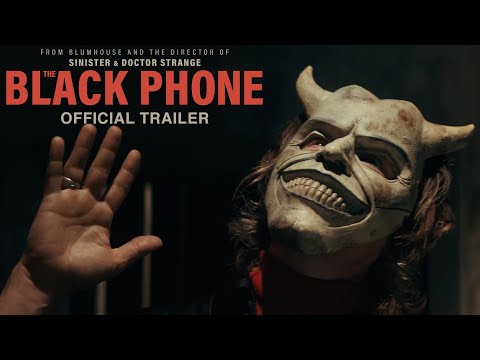
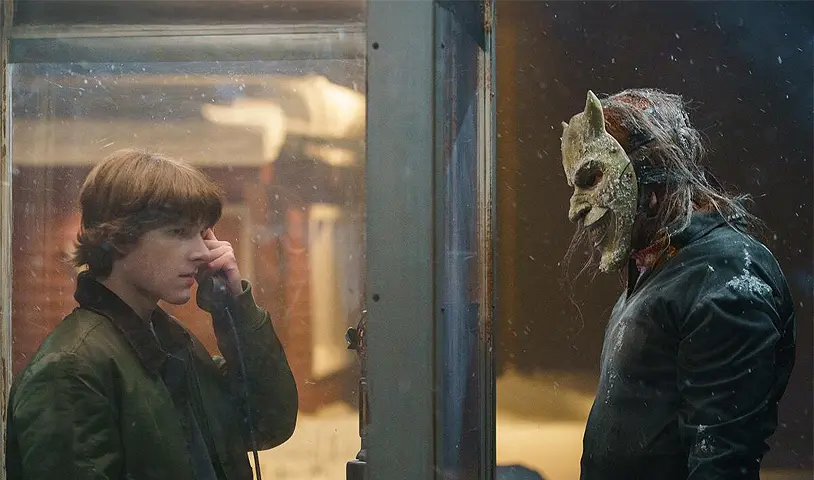
Appearing at the cell door, The Grabber, whose face is hidden by a strange smiling demonic mask, promises he wont hurt Finney. However the boy fears the worst and once left alone tries everything he can to get out. Failing miserably to escape, Finney resigns himself to a horrific and painful fate until suddenly the disconnected and broken black phone starts to ring.
Answering the creepy call, Finney hears nothing at first but soon discerns the voice of another boy, a boy he recognises as one of The Grabbers victims. The disjointed and disorientated spirit is as confused as Finney is however after the pair converse the vengeance filled being offers some help and a possible plan.
As time ticks by the serial killer’s victims continue to ring giving Finny hope and scrapes of advice on how to survive the living nightmare he has found himself in. Meanwhile his sister Gwen is having strange dreams that might just lead her to solving her brothers abduction before its too late.

Offering up a novel twist on the usual ghost story, The Black Phone serves as a sort of supernatural escape room with Finny trying different techniques offered up to him by the otherworldly callers. Blending jump-scares with back stories the spirits cold dead calls help the audience piece together not just what happened to the Grabbers other victims but also what is waiting for Finny.
The fascinating thing about the film is that at first it seems to play on the current craze for nostalgia that so many TV shows and movies use. Manipulating their audiences into pining for a cleaner, nicer, cooler, better time devoid of danger. After a while it is clear that Derrickson is aware that nostalgia is nonsense and darkness has always surrounded us no matter what year we were born in.

The town the film presents is filled with very real violence, dished out on the streets, in the playgrounds and behind closed doors. This is a place where the bogeyman is real and the police are so ineffectual they must seek out help from a psychic school girl.
Coming from a beaten and broken home, Finny and Gwen both experience their fathers wraith – especially Gwen, who we see receive repetitive lashings for talking about her predictive powers, a gift she has seemingly inherited from her mother and a gift that led to her suicide,
This violence is infectious spreading from homes to school where not only the main children are frequently threatened and attacked but also other students. Violence is power as we see early on when Finny’s friend pummels a much larger boy into a bleeding pulp, then extends this aura of protection to his pal.

Its not just physical violence but verbal as well and much of the film’s dark comedy is found in the foul mouth of Gwen, either yelling at her brothers tormentors or berating the inane local cops. Both kids are excellent throughout the film with Thames and McGraw giving the film the light it desperately needs amongst all the darkness.
Darkest of all is The Grabber himself, a being defined by the violence he perpetrates, donning different masks to suit the role he is playing from benevolent jailor to sadistic rule enforcer. Having become a mythical creature amongst the townsfolk, he believes he is beyond all rules, living only to punish the children he catches as judge, jury and executioner. Ethan Hawke is excellent in the role with his unhinged unnerving quality evoking Michael Jackson and Red Dragon’s The Tooth Fairy in equal measure.

In many ways, anger and violence is all that the restless spirits that communicate using the black phone have. And it is their hate of their killer and rage at what happened to them that has broken down the barriers between our world and theirs.
In an attempt to have his cake and eat it Derrickson’s offers up an extremely cathartic crowd-pleasing climax (that sadly undoes some of the work he had done building such a brutal and uncomfortable atmosphere). However it is understandable decision and at the screening I attended, it caused the whole crowd to erupt in applause.
Overall The Black Phone is gripping and scarily successful in not only telling a great ghost story, but also exposing the violent underbelly of everyday society that has always existed in the past, present and sadly probably the future yet to come.
| Movie Rating: |   |
Trailer:




7 Comments
[…] Black Phone […]
[…] The celebrity guest list includes Roger L. Jackson (the voice of Scream’s Ghost Face), John Kassir (Tales from the Crypt), the Boulet Brothers (Dragula), and Victoria Price, daughter of horror legend Vincent Price. Fans can also expect appearances from cast members of M3GAN and The Black Phone. […]
[…] Levi plunges into the abyss, and Drasa follows. Here, Derrickson leans into his horror credentials (The Black Phone, Sinister), introducing mutated monstrosities, grotesque biological horrors, and a creeping […]
[…] original Black Phone became an unexpected box office success following a staggered post-pandemic theatrical recovery, […]
[…] of Bram Stoker’s Dracula, originally written as a short story by Joe Hill, author of NOS4A2 and The Black Phone. Directed by Natasha Kermani, this film adaptation is a suspenseful trek into the story of a […]
[…] in 2022, The Black Phone grossed more than $160 million worldwide on a modest budget and earned strong reviews for its […]
[…] 8 artifacts, giving the visuals that stuttering nightmarish quality that worked so effectively in The Black Phone and Sinister. A lot of the film is intentionally under-lit, creating a patchwork of shadows for The […]