Blood and Black Lace (1964) Review
- Horror Film Reviews Slasher
William Knowles
- 0
- 7 minutes read

Before there was the slasher there was giallo. A genre pillar-stone of 60s and 70s Italian cinema, the giallo film brought with it a hybridity of thriller, noir and loose sexploitation resulting a genre identity recognised and praised by critics for the role it played in developing non-Hollywood cinema and influencing horror films for the following decades, chiefly the slasher subgenre.
Mario Bava’s Blood and Black Lace (1964), or in the direct Italian translation 6 Women for the Murderer, stands as one of the quintessential giallo films from a director who could be considered Italy’s Hitchcock. But why does Blood and Black Lace stand so high amongst other giallo films?
The film follows the classic murder mystery narrative of an unknown killer targeting a series of victims as part of a grander mystery. In this case, the victims are the models of a Roman fashion house all seemingly linked to a diary and the ensuing conspiracy. As the narrative progresses, so to do the familiar murder mystery questions, audiences will have asked during contemporary flicks in the murder mystery genre like Knives Out (2019). Who is this killer? Who will die next? Why are they in pursuit of this diary?

What makes Blood and Black Lace distinct in this narrative template is its film form and subtext. As a giallo feature, there is the aforementioned genre hybridity only possible in this era. It is shot almost like a neon noir, with harsh shadows and three point lighting being substituted for harsh colour and unnatural coloured lights. There is a consistent amount of beautifully extravagant shots that trump many of those found in modern horror. From blocking to camera movement, a clear intent and artistry lies behind cinematographer Ubaldo Terzano’s cinematography, who would later work as a camera operator for Dario Argento.
Such extreme colour usage in set design and cinematography was what initially echoed the works of Hitchcock. Sequences like the green tinged arc shot from Vertigo (1958) would fit into this vibrant yet dubious world. Bava’s extreme artistic decisions immersed me in this almost nightmarish state where the villainous nature of humanity is on full display. The association of black with death psychologically gives an ominous feeling to the audience while the garish lights feel somewhat hypnotic luring you into danger and an exaggerated reality.
To build off these Hitchcock parallels, is the undercurrent themes of paranoia and suspense as well as the sexually charged iconography of its female model characters which dominate the works of other giallo films. In regard to the representation of women in film, Hitchcock’s male oriented perspective has provided a blueprint for the feminist theories of Mulvey’s ‘male gaze’. Chiefly, again referring to Vertigo, it has been argued that cinema has traditionally aligned with the perspective of men by men for men meaning that women conform to sexualised standards for pleasure. In his retrospective piece on Blood and Black Lace, Glenn Kenny refers to how despite the women only being murdered the character’s dialogue heightens the sexual undertones suggesting an influence of misogyny, also noticing the thematic similarities to Hitchcock.

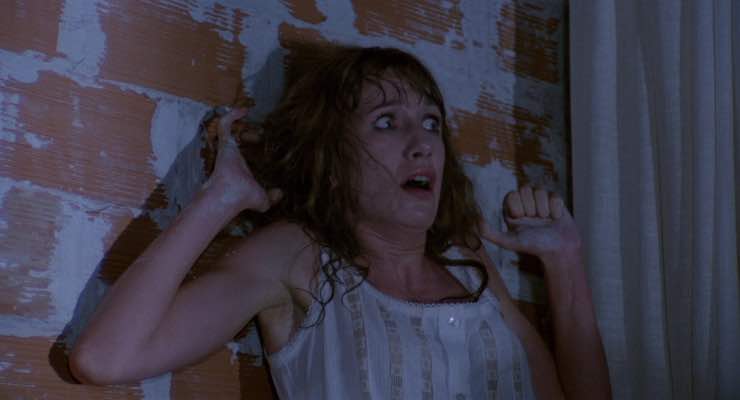
This possibly links to the theme of patriarchal control. In the closing twists of the narrative, Bava examines the dichotomy between a central female and male character and just how equal the two are. The consistent paranoia, best symbolised by Greta’s pleas to stay together during the murderous spree, is another thematic idea that makes up the giallo genre. Through editing techniques like long takes and blocking to obscure incoming subjects, there is an ever lingering sense of dread creeping through the shots that sells the character’s fear and confusion.
The catalyst of this tension, the killer, is also a key point of discussion. The killer is seemingly a blueprint for the slasher villain archetypes, primarily Michael Myers of the Halloween series and Jason of the Friday the 13th series. They aren’t merely a concealed identity but a near omnipotent killing machine motivated only by their own goals. Furthermore, they share the visual distinction of a mask to remove any semblance of humanity. And while, the killer in Blood and Black Lace, is not a slasher villain, the similarities and the long standing cultural impact Bava and the giallo genre had on cinema from the 70s onwards solidifies the influence.

Even beyond the clearest connection to slashers, Blood and Black Lace has influenced further films like those of Italian-American Martin Scorsese’s Kundun (1997) and Spanish Pedro Almodóvar’s Matador (1986) who have gone on to directly reference scenes.
It is ultimately this deeper subtext and cultural legacy which has propelled Blood and Black Lace to one of the best of giallo. What could otherwise be an unremarkably redundant plot is saved by the rich culture of giallo and sheer talent of the crew and cast involved. It isn’t hard to see why Bava is so highly praised. For anyone looking for an introduction to the history of giallo film, you would be doing yourselves a disservice to ignore Blood and Black Lace.
Blood and Black Lace is being re-issued in glorious 4K and will debut on ARROW from 25th September.
| Movie Rating: |   |
Blood and Black Lace trailer