
‘Jaws’ at 50: 5 Blockbuster Lessons Modern Movies Still Steal
- Horror Features
 Jasmine Clarke
- 0
- 7 minutes read
On June 20, 1975, Universal rolled the dice on a young director named Steven Spielberg, a malfunctioning mechanical shark, and a modest beach thriller. The result, Jaws, changed the way studios make, market, and even think about movies. Half a century later, every summer tent-pole still carries its DNA. From Jurassic Park to A Quiet Place to this year’s Wolf Man, the fingerprints are easy to spot once you know where to look.
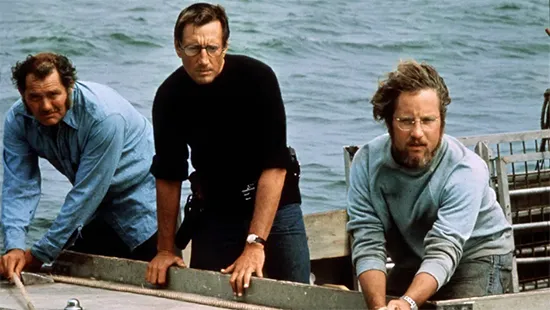
Below we share five lessons modern blockbusters keep borrowing from the great white grand-daddy of them all.
1. Show Less, Scare More
The Lesson: When in doubt, hide the monster and let imagination do the heavy lifting.
Spielberg didn’t plan to keep Bruce (the famously stubborn mechanical shark) off-camera; the prop simply wouldn’t cooperate. Forced improvisation turned into masterclass suspense. The audience only sees brief flashes – a dorsal fin slicing the surf, a floating half-sunken dock, a red plume in otherwise blue water – and fills in the rest with nightmares of its own making.
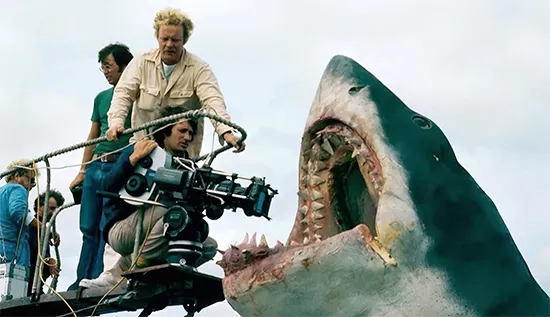
Studios still reach for that playbook. Cloverfield and The Blair Witch Project built entire marketing campaigns around what they refused to show, while A Quiet Place withholds its creatures until the midway point, proving that dread, not CGI, is the currency of lasting scares.
2. Theme Music That Bites
The Lesson: A simple, repeatable motif can become the movie’s second villain.
John Williams wrote the Jaws theme in two pounding notes. That minimalist pulse became an audible countdown to carnage, ratcheting anxiety before a single frame of danger appears. The track won an Oscar and turned pool noodles into potential predators for generations of swimmers.
Today, studios still chase that earworm effect: Hans Zimmer’s BRAAAM in Inception, the lightly-struck keys that follow Michael Myers, or Ludwig Göransson’s bone-rattle for Oppenheimer. You can hum them in three seconds flat, and that’s the power.
3. The Three-Act Set Piece
The Lesson: Treat major action beats like chapters in a novel, each one bigger and riskier than the last.
Jaws is often remembered for two parts: the beach attacks and the shark hunt. Missing is the fact that both halves are divided into escalating mini-showdowns: Alex Kintner’s tragic swim, the estuary rescue, the opening night dive, the barrel chase, the cage, and finally Quint’s grisly farewell. Each leaves Chief Brody more desperate and the shark more menacing.
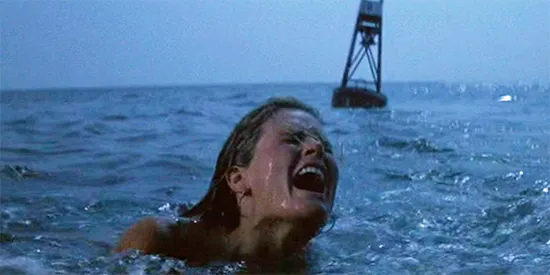
Modern blockbusters from Mission: Impossible to the MCU structure their spectacles the same way. A chase here, a mid-film ambush there, and a final face-off that dwarfs what came before. It keeps popcorn flowing and tension rising without losing the audience to sensory overload.
4. “This Summer” Becomes a Brand
The Lesson: Create an event, not a release date.
Universal’s decision to blanket TV with Jaws spots weeks before opening shaped modern marketing. Up to that point, studios rolled films out slowly, letting word-of-mouth grow city by city. Jaws hit 465 theaters on weekend one, backed by an unprecedented television ad blitz. It invented the wide-release blockbuster and the idea that summer was for filmmakers, not just ice-cream vendors.
Flash-forward to today’s Comic-Con teaser drops, Super Bowl trailers, and TikTok countdowns. Every studio hopes to recapture that opening-weekend feeding frenzy Spielberg’s shark started.
5. Characters First, Carnage Second
The Lesson: Audiences return for people, not pyrotechnics.
Chief Brody’s fear of water, Hooper’s sailor-sized ego, Quint’s Indianapolis monologue – none of it was necessary for a shark-attack thriller, but all of it made the film unforgettable. Their banter over scars, their sing-along to “Show Me the Way to Go Home,” and their professional grudges ground the spectacle in stakes we actually care about.
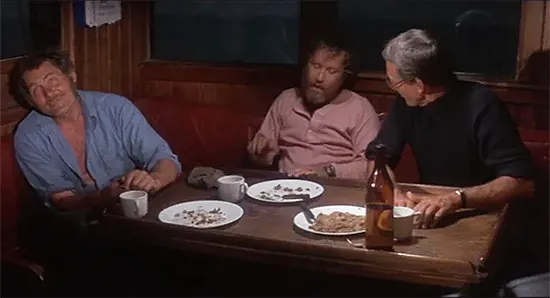
Big-budget films that aim higher than box-office spreadsheets follow suit. Guardians of the Galaxy, Get Out, Top Gun: Maverick – each spends real runtime on character before unleashing chaos. It’s a simple rule: if the crowd cheers when someone survives (or gasps when they don’t), you’ve done the homework.
Fifty years on, Jaws still circles every major release, reminding filmmakers that tension beats volume, melody beats noise, and characters beat carnage. As we gear up for another summer of sea monsters, dinosaurs, and intergalactic invasions, keep an ear out for those two low notes echoing under the bombast. The market might be infested with shark movies nowadays, but Spielberg’s film is still the one casting the longest fin-shaped shadow.
Jaws trailer