
Exclusive interview: Mitzi Peirone on ‘Saint Clare’
- Interview
 Erica Vilkus
- 0
- 12 minutes read
When Mitzi Peirone burst onto the genre scene with her daring debut Braid, she was heralded as a bold new voice in psychological horror. Now, the award-winning Italian director returns with Saint Clare, a haunting and blood-soaked Southern Gothic thriller that has already turning heads. Starring Bella Thorne in a career-defining performance, the film blends themes of morality, faith, and female rage into a surreal tale of vengeance that’s as thought-provoking as it is visceral.
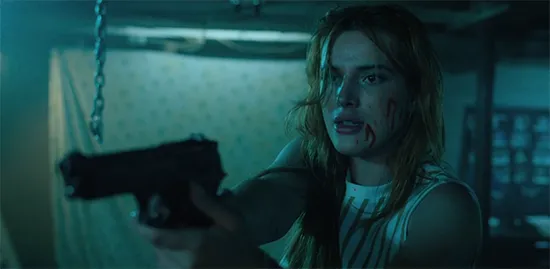
Based on Don Roff’s novel Clare at Sixteen, Saint Clare follows a young woman who believes she’s an instrument of God, dispatching those with evil intentions in her small town. But as her violent quest for retribution deepens, so too does the darkness surrounding her. With a supporting cast that includes Ryan Phillippe, Rebecca DeMornay and Frank Whaley, an original score from Zola Jesus, and a screenplay co-written by Guinevere Turner (American Psycho), this is a film that balances arthouse sensibilities with grindhouse grit.
As the film prepares for its UK digital release on 21 July, we caught up with Peirone to discuss the inspirations behind Saint Clare, from Southern Gothic influences to her fascination with the female antihero. She also reflects on working closely with Bella Thorne, her love for psychological thrillers like Oldboy and Black Swan, and why she still storyboards every shot by hand. Below, Mitzi opens up about crafting a film that blurs the line between retribution and fanaticism, and why she believes horror is the perfect vessel for exploring existential and ethical questions.

Mitzi Peirone on Saint Clare, Bella Thorne, and Crafting a Female Antihero for the Ages
Love Horror: Saint Clare is the story of a psychologically tortured teen serial killer who believes she is an instrument of God. There are a lot of themes to cover, from coming of age to religious fanaticism. What drew you to directing a story like this, and what can audiences expect from the film?
Mitzi Peirone: I am fascinated by the female anti hero trope and drew from films such as Audition by Takashi Miike and A Girl Walks Home Alone at Night by Lili Ana Amirpour, honouring the psychological thriller/horror subgenre of the “good for her” realm, while building on the idea that someone like Clare attended catholic school, which brought me to reflect upon ethical and moral dilemmas. I think that audiences can expect a story that poses questions on right and wrong, on whether personal retribution can make up for a lack of social justice and to what limit is it acceptable to take such retribution, before it becomes just as dangerous and wrong as the evil it is trying to eradicate. With all the cerebral themes we infused the film with though, the reactions so far have been that the picture remains an accessible and rewarding watch.
Since this film is based on Don Roff’s novel Clare at Sixteen, are there any horror books that you would like to adapt to the screen or see adapted?
I am looking forward to seeing the TV adaptation of The Shards by Bret Easton Ellis, which unsettled me just as much as Less Than Zero did; not a horror but talking about screen adaptations, I can’t wait for Janette McCurdy’s I’m Glad My Mom Died. I would love to adapt any of Emma Cline’s novels The Guest and The Girls although neither are horror.

The setting of Saint Clare can be considered “Southern Gothic,” which is very on trend right now with artists like Ethel Cain and films like Sinners. What were some Southern Gothic influences you drew from while working on Saint Clare?
The pillars of Southern Gothic just suited the themes of this story so well: the darkness that linger in suburbias, the alienation of the sprawling yet solitary American landscape, plagued by issues around religion, social inequalities and marginalization, only exacerbated by the dizzying humidity, the rising, hallucinating heat that can drive one mad, and a sense of unshakable suffocation, enhanced by touches of mystery, dark humor and at times the supernatural. Not direct references but I watched To Kill A Mockingbird and The Night of the Hunter at a young age and they struck a chord undoubtedly.
Bella Thorne’s performance as Clare was integral to telling this story, how did you approach bringing Clare to life with Thorne?
Bella is such a 360 collaborator and an exceptional artist, and writing the character with her in mind was a delight, since we had known each other for several years and had become really close friends. I wanted to craft a role that she would have been intrigued by, but it was Bella’s ability to ground and yet elevate Clare that made her so nuanced, complex and real. We discussed influences such as Joan of Arc and looked at cases of real women that took matters into their own hands against their perpetrators, which made us aware that there must be a loss of trust in institutions if that happens. This social aspect enlarged the scope of our character development, and whilst Clare is fictional, what she fights for is real. Bella was also a blessing on the action front, building the stunt sequences with us: one instance in particular I recall we were rehearsing this complex car action sequence and she started driving with her foot because without spoiling it – her hands were busy – and I thought that was just such thrilling and unique addition that worked so beautifully on screen. Bella was also very involved in post production and that’s such a rarity to have your lead actor be so dedicated and present through and through.

Coming off of your debut feature, Braid, what were some directorial lessons learned that you applied to Saint Clare?
Storyboarding as much as possible I think is crucial to preparing for any film – I do it by hand, I don’t use digital pre-viz tools – but especially when the pace is as fast as when we shot Saint Clare – which was 15 days of production – then the more you rehearse, shot list and storyboard, the best you make the exact composition and design of the shot happen on screen.
I think treating cast and crew like family will make a film go the extra mile, everyone’s working gruelling hours and the more care, passion and respect there is, the more efficient and inspiring the experience will be – which in my opinion, does affect the final product, how the people making the film felt while they were crafting it.
And from Braid I learned that thinking about the edit while writing and shot listing is fundamental, and when in doubt, it is best to always get some inserts to cut to, helps piece a scene together while adding detail and tempo.
What were some of your favorite moments working on Saint Clare?
I think crafting the action sequences was one of the most rewarding and stimulating parts of the process, there is something very pure and theatrical about it, the suspension of dialogue for a moment of pure vision and sound. On the other hand, I think shooting the first interrogation scene with Bella and Ryan was very engrossing because of the tension they brought to the scene. But also while we were shooting it, I was editing it in my head knowing it will be cut with splinters of her paranoid imagination thinking about all the worst case scenarios as she is lying to a detective – that was to me an exquisite moment on set and it worked perfectly in post.

Both your films, Braid and Saint Clare, have psychological horror/thriller elements to them. Is this your favorite horror sub-genre? Do you have any favorite films in this category that may have influenced your work?
I love psychological thrillers the most, I love questioning reality, challenging ideas we may have of facts or of ourselves or others. I love a narration that’s dreamy and mind bending , feeling blown away by plot twists and reveals, I love discovering and unravelling a mystery. I think my films – including the two I wrote after Saint Clare – are both about outcast women trying to solve a riddle.
I’ve heard the quote that filmmakers make the same film over and over and maybe that will be true for me too. For how my brain works I need to be intellectually challenged and engaged with a complex plot, but landing on a climax that lands on an emotional level. I think psych thrillers are the perfect for exploring philosophical and existential themes, how we are inevitably ruled by our mind and our perception. I have so many favourites, The Others, Signs, Mullholland Drive, 7even, Shutter Island, Inception, Black Swan, Perfect Blue, but most of all the original Oldboy by Park Chan-wook.
Can you share any upcoming projects with us, and where can we keep up with them?
I’m getting quieter and quieter these days especially on socials, I’m enjoying the introspection and meditative state that writing a script requires me to be in, which I have been with the two features I wrote after shooting Saint Clare. But if i were to update anyone on them it’d be on Instagram, which again, has become a place I don’t participate in as much anymore, it makes me feel empty. But the blank page, with its immaculate vastness and its privacy has allowed me a place to feel sane and fulfilled in. That’s to say I’ve been writing abundantly – a scifi, a neo-noir murder mystery, a tv pilot. Things take a long time, and like aerialists, artists know that to look down is to fall. So I try not to look.

Prepare yourself for a tale of redemption, retribution, and psychological torment when Saint Clare arrives on UK digital tomorrow, 21 July, from 101 Films.