
Interview: Andy Edwards on ‘Rumpelstiltskin’
- Interview
 Tom Atkinson
- 0
- 14 minutes read
Fairy tales were never meant to be safe. And in Rumpelstiltskin, the latest feature from writer-director Andy Edwards, they most certainly are not. Forget Disney gloss and bedtime morals. This is a tale of dark deals, demonic pacts, and a leering, latex-skinned imp who doesn’t just ask for your firstborn – he demands it with teeth bared.
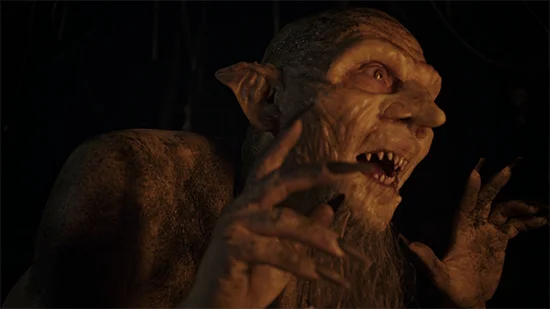
Premiering at Pigeon Shrine FrightFest Glasgow and now released in the UK via Miracle Media, Rumpelstiltskin marks another audacious step for Edwards, whose eclectic career spans sun-drenched zombie comedies (Ibiza Undead), psychological thrillers (Graphic Desires), and blood-soaked British folklore (Punch). But while the director is no stranger to horror, this film takes him into new territory – embracing fantasy, period filmmaking, and full-body prosthetics to resurrect one of the Brothers Grimm’s creepiest characters.
What sets this retelling apart is its reverence for the original text. Unlike other horror updates that twist childhood favourites into slashers or camp parodies, Rumpelstiltskin stays remarkably true to its source, mining the folklore for its implicit terror rather than reinventing it entirely. The result is a film that feels both timeless and timely – a cauldron of medieval grit, modern gore, and folkloric dread, stirred with bawdy humour and brash feminist energy.
But getting there wasn’t easy. Filmed in historic locations (some reportedly haunted), packed with challenges both supernatural and logistical, and led by a monstrous central performance buried under hours of makeup, Rumpelstiltskin is a testament to what can be achieved on a British indie budget – with vision, persistence, and just a pinch of black magic.
We caught up with Andy Edwards to talk secrecy, spinning straw into gold on a shoestring, and what the UK horror scene really needs to thrive.
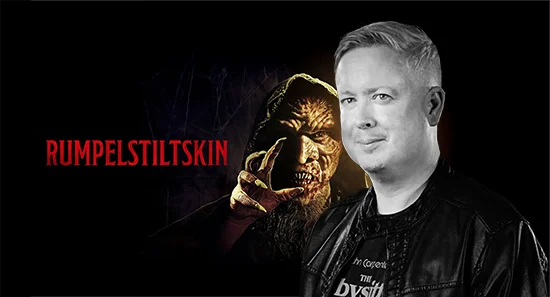
Interview: Andy Edwards
Love Horror: Rumpelstiltskin had its world premiere then at Pigeon Shrine FrightFest in Glasgow. But ahead of that, there was a lot of secrecy around the project. Even the trailer wasn’t released until around the time of the festival. Why was it kept so quiet?
Andy: Yeah. Part of that is building excitement. And part of that is the fact that we’re working in quite a competitive environment of low budget fairytale horror at the moment, and there’s a good chance that if you make something, someone else will try and make it too. Therefore, you don’t show your hand too soon. For instance, now our film is out, but somebody else is doing another Rumpelstiltskin film.
So for people who haven’t had a chance to see it yet, just can you let us know what they can expect to see?
So, Rumpelstiltskin, as it’s name suggests is a fairy tale horror. And it actually follows the Brothers Grimm story fairly faithfully. Obviously with a lot of these other fairy tale horrors, we’re seeing people take quite cutesy characters and make them evil or producing a slasher. And this means they do have to deviate quite a lot from the source material.
Rumpelstiltskin on the other hand is a creepy little fucker anyway. So it didn’t really need too much changing from the original story to make it, a horror. A lot of it was just emphasising the the horror elements, specifically the folk horror elements that are in the story. The other task is expanding on it, because the original story is only like a page or so long. Most of it focuses on the things the characters did, but not why they did them.
A lot of the work was expanding the backstory and make the characters feel like real people, make the world feel like a real world, even though it is a fantasy medieval world. It’s quite nice to have something like that, something that is well known, but at the same time gives you room to be creative.

Looking back at the last three films you’ve directed, there’s Punch, Cinderella’s Revenge, and now Rumpelstiltskin. There’s a clear theme running through of lore and folk tales. What’s behind that?
Well, Punch and Rumpelstiltskin were my own projects that I devised myself. And they’re kind of born from the fact that I’ve started producing now as well as directing. So my director brain wants to tell original stories the whole time, and my producer brain is busy trying to find any IP that is free which will help us stand out in the marketplace. There are so many low budget horror movies being made right now that it’s quite difficult to stand out.
So where Punch and Rumpelstiltskin landed were kind of in that sweet spot for me of characters with enough of a history and a backstory, that people would know about them, but also enough room to tell and original story about them, and take it to places that you might not expect. And of course, both characters seemed fairly evil. It didn’t take a huge leap. If you try to take, Winnie the Pooh to horror, that’s that’s a big leap.
I’ve got a young son and a few years ago, I would read him the fairy tale stories before bed. Some times I would wonder if I needed to skip some of them because they could be pretty horrific and give him nightmares. And Mr. Punch always scared me as a child. So there, I was taking things that were creeped me out as a child and expanding on them, just to see if we could scare a few adults with them too.
With Cinderella’s Revenge I was used as a director for hire, so that wasn’t a project I’d had to start myself. But it did give me the chance to attempt a period film on a low budget.
Before then I wouldn’t have tried to make a period film on a British indie budget. But I worked with my co-producer Rebecca Matthews on the film, and she pulled together miracles for that film. The I saw that you can do period on a low budget.
Shooting a period project is a lot of fun. If you’re shooting a contemporary horror in a flat or a cafe, the cast is dressed the same as the crew. It’s not as fun as when you have horses, knights and ballgowns, and the set is a castle. That’s when you think, “oh, I’m making a proper movie”.
So making a period film must come with more challenges. How did you have to do things differently?
Well, you’re involving things that animals, and the props and sets have got to look real, they’ve got to look authentic for the time.
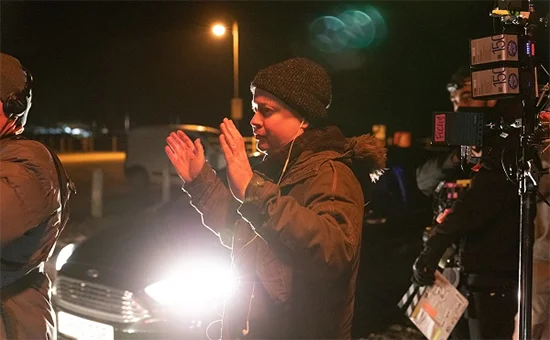
Everybody says, if you’re doing low budget indie, you should stick to what you’ve got, stick to the locations you’ve got, stick to a small cast. And obviously there’s the old saying ‘you should never work with children and animals’. But we ended up having children and animals. We had knights in armour, we had castles, we had dungeons.
I think the biggest challenge is that, if you’re doing something contemporary, if you need a prop, you can just go to Asda, or if you need an extra costume, you can go to the local Primark. If you need missed a shot, you can just go into the street the next day and guerrilla shoot it. You can’t do any of that on a period project. Your location has to be selected beforehand, your props and your costumes all have to be found beforehand.

Luckily, we weren’t set on a fixed period in time as it’s a fantasy world. So, as long as everything felt right for the time, the costumes and the locations didn’t actually have to be 100% historically accurate. That gave us some flexibility.
We shot some of the film in a reenactment village that had Saxon houses, and then we shot in a Tudor hall. And apart from one location, which was a set build, the rest is all genuinely old. Some of the places we shot were 500 years old, which again, brings its own challenges.
The good part of that is you can you can pretty much film everywhere, and it will look great. And it will fit your, your story. The bad part is obviously that comes with a whole bunch of, restrictions on what you can and can’t do. You don’t want your crew to break anything.
Some of the locations were haunted too, and some of cast had some ghostly encounters on set, so that was something else to contend with.
Ghosts?! You’re going have to tell us some more about that.
Well, one story was around our lead actress, Hannah Baxter-Eve. Some of the scenes we shot at Anne of Cleves house, in Lewes. And she was one of Henry VIII’s many wives. The house is 500 years old and has been turned into a museum, but it has been kept pretty much as it was back then. So Hannah was the first to arrive on set one day and she went inside to the toilets, which are downstairs, and you have to go through what was the old kitchens. And as she was going in or out, she saw this figure – an old woman sat in a chair, over by the fireplace in the kitchen. And when Hannah turned to look again the woman had gone.
She had thought nothing of it really, but later she was speaking to the museum manager who was supervising us and said “I hope you don’t think I’m weird, but I saw something downstairs, which was a bit strange”. The manager looked at that in the dead in the eye and asked “was it the old woman in a purple cloak sat by the fireplace?” and Hannah felt a chill through her body. The manager said they see the woman quite often.
What’s your take on current state of British independent horror?
I think the fact that there are a whole bunch of us doing it is it is a good thing. And I think what we’re starting to do, and I know that I’m trying to do, is start communicating a bit more so that we don’t have everybody working in little silos around the country.
We want to be coming together at places like FrightFest, Horror-on-Sea, Romford Horror, all the other festivals, and getting together to share tips and information. I think the important thing to realise is we’re not in competition with each other at all. Our competition is the US really.
And we need to show the markets, the distributors and the streamers that British horror is good and can do well. I think the talent is all here but I think two things need to happen:
We need to collaborate even more – and a lot of that is talking about what comes after the making of a film in terms of the sales and distribution process, because that is a minefield.
I think the more that we kind of help each other out in that, the better, because there are a lot of pitfalls that film makers can fall into. That I’ve fallen into that myself. So I think we can help each other a lot with things like casting and crewing. Just things that will help everybody, but especially the business side of things. Then we can all start to grow and, hopefully make some money out of this.
The second thing that we need is some kind of recognition from the powers that be, such as the BFI. That genre film is successful and a creatively diverse market.
We’re kind of ignored and nobody’s ever going to get BFI funding from them, you know, the people that I know, the people that are out here working working, making films.
What are you working on next?
Well, I’m working on a whole bunch of things. I’m not sure which ones will get done first? Punch Two is in the is in the works. Possibly even a Rumpelstiltskin Two, depending on how things go. And then I’m working with a bunch of other writers and other directors, looking at things to produce at the moment. Some quite exciting stuff from some new writers, which I’m hoping to get out there. And again, it all feeds into that thing about trying to grow the UK horror scene.
I’m trying to grow my little production company, and if it’s just films that I make, I only have the kind of the energy to make one or two a year. So that’s why I’m looking at getting other directors and other writers in, and we can upscale production.
Rumpelstitskin is available on digital from today, 7 April, courtesy of Miracle Media.