
Dooba Dooba (2024) Review
- Horror Film Reviews Psychological
 Darren Gaskell
- 0
- 6 minutes read
Dooba Dooba opens with a VHS tape kicking into life, the following caption appearing: “A final project presented by Monroe Jefferson to the adjudicators, in partial fulfilment for a degree with honors of high school equivealiancy” (sic) before cutting to the many views of the Jefferson household via the numerous, hidden CCTV cameras that have been set up to cover most of the place since Monroe’s brother was killed by an intruder several years ago.
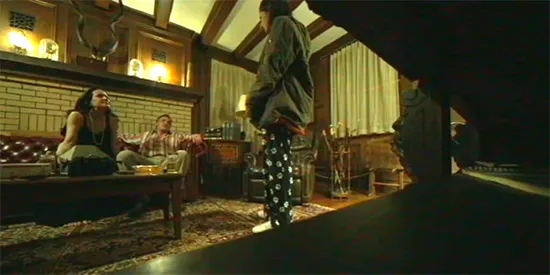
Now sixteen, Monroe (Betsy Sligh) suffers from extreme anxiety and her parents Wilson (Winston Haynes) and Taylor (Erin O’Meara) rarely leave her alone. That is, until tonight, as Wilson and Taylor have finally arranged to stay overnight with some friends and have left Monroe under the supervision of Amna (Amna Vegha). Amna is warned about Monroe and that she should repeat the phrase “dooba dooba” if she’s walking around the house so that Monroe can identify a calming, familiar phrase and doesn’t have to cope with any sudden surprises.
As a subgenre, found footage can host some of the most uninspiring and lazy takes on the “blurry footage of folks being terrorised” template but writer/director Ehrland Hollingsworth has restructured the form in a way that’s smart without ever being smart arsed, subverting the viewer’s expectations time and again to bring us something that’s strange, creepy and genuinely unnerving.
From the opening moments, the behaviour of Monroe’s parents seems a little off, then much more so when Wilson goes into a random rage at his inability to correct pronounce Amna’s “ethnic” name. But Amna’s nice, she’s polite and she lets it go. The audience is sure this will be a mistake but the different directions the story takes don’t cleave to the usual tropes of wandering around a dark house, waiting for sudden noises, wondering when a killer is going to show up. Where Dooba Dooba heads is a lot weirder and far more chilling than that.
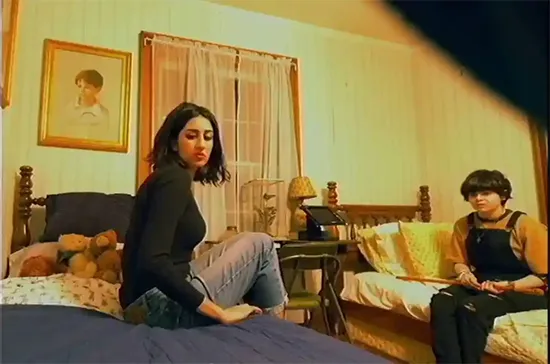
The overarching video project, filling the gaps in the home-based security footage and focused on presidents across the years, feeds into the action in various ways, notably a quote which states the power of that particular office means that the person in power can carry out acts without recourse to the legal parameters that would restrict everyone else. A slide show about Jeffrey Dahmer also cuts into the recording, which means that it won’t take a genius to realise that the message of absolute power plus an interest in serial killers adds up to trouble for whoever’s sucked into the orbit of this strange family unit.
The framing of the action is disorienting, either too far away or too close to ascertain the full detail of what’s going on or relegating the characters to a relatively small portion of the shot, leaving a huge space in which we’re just waiting for something to creep – or indeed, leap – into view. It’s this knowledge of the subgenre’s tick boxes which allows Dooba Dooba to keep the watcher in a constant state of unease while biding its time to pull not just one but several rugs as the second half goes into ick overdrive, one scene in particular building to something skin crawlingly dreadful.
The acting is just the right side of performatively weird, with Sligh nailing the mercurial nature of the awkward, unpredictable Monroe. Haynes and O’Meara are instantly odd but as they’re reintroduced later in the proceedings, they’re skilled as playing off their outlandish behaviour as a privilege of their situation. Vegha, in a role which requires a certain duality of thought and deed, is an amiable lead and provides a neat twist on the representation of the Final Girl.
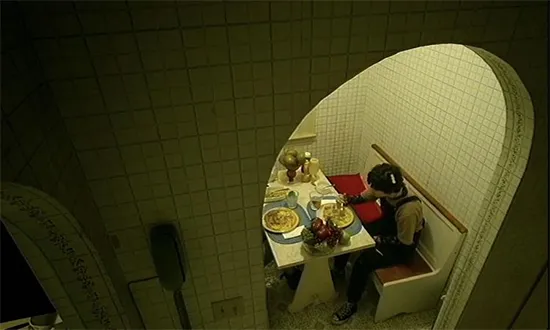
Rather than kick its heels for an hour and deliver only when the runtime (and budget) requires a memorable finish to offset all of the wandering around and sudden, off camera noise, Dooba Dooba constantly feeds in information – most of it not immediately obvious – to maintain the feeling that something definitely isn’t right. A clip of a band playing Hail To The Chief with all of the queasy wow of the sound from an old tape. A cut to an outhouse, and its worryingly furnished interior, which may be close by. A timeline that suddenly veers non-linear. Unexpected, shocking moments of violence.
The fact that each member of the Jefferson family also has the first name of a President, combined with their eerie focus on the country’s reparations for historical atrocities, doesn’t conceal the allegory with a certain type of white American’s feeling of superiority, perceived right to rule and deep seated racism but at the same time doesn’t hit you over the head with it. The desire of these people to act with impunity has chilling parallels with certain elements of modern society which adds to the overall horror.
With its lo-fi, scratchy visuals and compressed format, Dooba Dooba is an unnerving, claustrophobic experience in a cinema but it’s also very much at home in the home. You’ll be looking around the corners of your own place just to make sure no one’s there. Ehrland Hollingsworth has brought something new and harrowing to this well-worn subgenre, reminding us that real fear lies in the most outwardly mundane of places.
See it on the smallest cinema screen possible.
| Movie Rating: |   |
Dooba Dooba trailer