
Brea Grant and Ed Dougherty take on work, capitalism and horror with ‘Grind’
- Interview
 Jasmine Clarke
- 0
- 6 minutes read
Horror has always had a knack for making everyday anxieties feel monstrous, and with Grind, Brea Grant and Ed Dougherty have turned one of the most universal sources of modern misery into an anthology of escalating workplace nightmares.
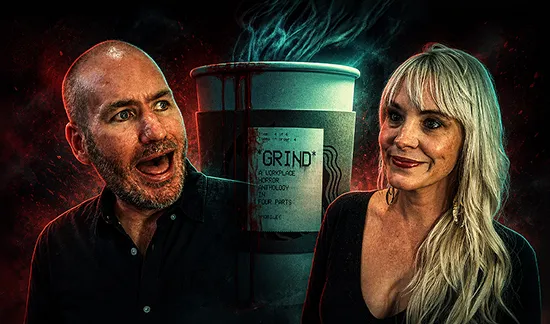
Co-written by Grant and Dougherty, with both directing individual segments alongside Chelsea Stardust, the film tackles multi-level marketing, delivery apps, content moderation and workplace organising through a mixture of horror, satire and dark comedy. It is a film about jobs, money and survival, but one that clearly has no intention of behaving like a conventional social drama.
“It’s a horror anthology with a great deal of comedy, kind of a satire of late stage capitalism and trying to make it in our day and age, kind of like a Black Mirror esque thing,” Dougherty tells Love Horror. “And it’s super fun.”
Grant is just as keen to emphasise the entertainment value alongside the film’s more pointed ideas.
“It is really fun. It’s an anthology. So if you like anthology films, that is a great reason to see it,” she says. “People laugh through the movie, but I think it also has like a fun message, and it’s sort of something everyone can relate to right now where we’re all trying to make ends meet.”
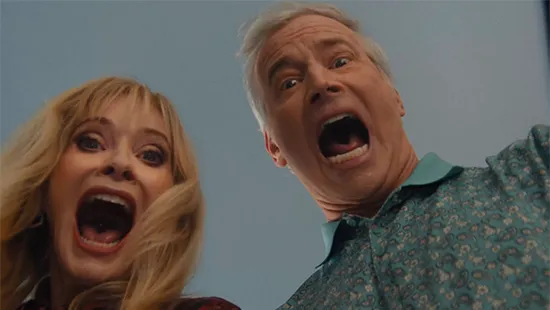
The anthology format gave the filmmakers room to attack the same broader theme from different directions, while also allowing each section to develop its own identity. It was also, Dougherty admits, a decision that came with commercial risks.
“I love anthologies. I think people love anthologies, but the general opinion of like a distributor, they’re very against anthologies,” he says. “So we knew going in it was going to be a hard sell, but we’re like, oh, we’re going to make it good. We’re going to make it different than other anthologies.”
Among their reference points was Michael Dougherty’s Trick ‘r Treat, along with Southbound, particularly in the way separate stories can be made to feel like pieces of one larger film.
For Grant, the process also offered a welcome change from directing a feature alone.
“This is fun because I have a partner in this, which is makes it a little less nerve wracking because there’s somebody else who can also talk,” she says. “We can kind of, you know, both commiserate together when we’re nervous.”
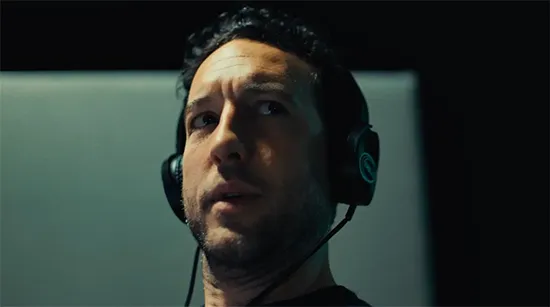
That collaborative spirit extended into the production itself, which Grant describes as completely DIY. Much of Grind was shot in homes belonging to the filmmakers and their friends, with ambition frequently outweighing resources.
One of Grant’s most memorable achievements involved a rotating room set she had wanted to use for years.
“I’ve always wanted to shoot on a rotating room like a giant stage rotating room, and I was able to do that on this movie,” she says. “It is wildly pulled off in the budget that we had, because basically we skimped on everything in that segment except this one set, which we had for one night, a full night shoot.”
The sequence was not even part of the original plan.
“What if I put it in a rotating room and the guy has to walk on the ceiling? And that’s what I did,” Grant recalls.
Dougherty’s standout production memory was equally intense. His favourite segment, centred on content moderation, included a punishing 14-page day with Rob Huebel.
“We only had Rob Huebel for one day, and it was a 14 page day,” he says. “And that was an exhilarating day because he was nailing everything on the first take.”
By 3am, however, the pressure was beginning to show.
“I was like, we might not do it, but one of the final scenes reaches an emotional place that is like amazing to me. And I think it helped that it was such a brutal, long day.”
For Grant, returning to FrightFest offered a reminder of exactly why those difficult shoots are worth enduring.
“This is like when you’re making your movie and you’re, like, in a bad mood and you’re like, why am I doing this?” she says. “You’re like, oh yeah, I get to go to like a cool festival where people are excited and this is the reason we do it.”
That sense of audience participation feels particularly suited to Grind, a film built around frustrations almost everyone in the room is likely to recognise. Whether it is an impossible boss, an exploitative platform or the grinding pressure simply to keep earning, Grant and Dougherty have taken the realities of contemporary work and pushed them somewhere nastier, stranger and considerably more entertaining.
Watch our full interview with Brea Grant and Ed Dougherty below, where they discuss making Grind, embracing horror anthology storytelling, creating the film on a DIY budget and the moments that nearly pushed the production to breaking point.
Brea Grant and Ed Dougherty Grind interview