
The Nameless Ballad (2026) Review
- Ghosts Horror Film Reviews
 Tom Atkinson
- 0
- 5 minutes read
During our recent interview with Federico Zampaglione, the filmmaker made it clear that has never been interested in following a set formula. His last film, The Well, may have embraced the blood-soaked excesses of Italian splatter, but his latest work, The Nameless Ballad, turns inward. This time the monster is harder to define. It may be supernatural. It may be addiction. It may simply be the horrible suspicion that the one thing which once made you special has deserted you.
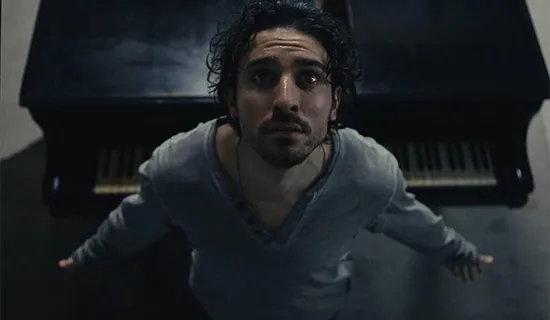
Jamie Ward plays Sam Gallo, a musician whose first album was successful enough to make the second one feel impossible. The songs have stopped coming, the label wants another hit and prescription drugs are doing increasingly poor work as a substitute for inspiration. His solution is to retreat to an isolated Italian villa where he spent childhood summers, hoping the scenery might shake something loose.
And shake loose it does, but not quite as intended.
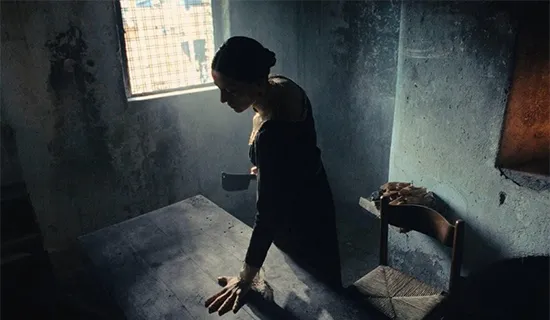
Arriving at the property he is greeted by Rosario, the caretaker, and is drawn to an old piano that sits, locked, in one of the many spacious rooms. After doing some exploring, Sam finds a key and diary buried under a tree that is connected to the old piano and fragments of a life dating back to 1937. The key unlocks the piano, and with it dream-like visions that begin to pull Sam towards a mystery that is somehow connected to his own creative paralysis. Zampaglione and co-writer Barbara Baraldi keep the supernatural element deliberately slippery. Sam is exhausted, medicated and spending far too much time alone, so every apparition carries at least two possible explanations.
Zampaglione knows this territory from another angle, being the frontman of Italian band Tiromancino, and there is something convincing about the way The Nameless Ballad treats creativity as both privilege and burden. Sam doesn’t just want to write another song. He needs to prove the first one wasn’t an accident.
The pressure follows him to the villa. Reviews and social media speculation ask whether Sam Gallo is a genuine talent or another one-hit wonder. His management wants something marketable. Even his relationship with Tania (Alana Boden) is tangled up in the song that made him famous, inspired by another woman before being packaged and played repeatedly for strangers.
Ward is excellent at making that artistic anxiety believable. He looks convincing on stage and equally convincing staring at an instrument as though it has personally betrayed him. Sam’s deterioration happens through repetition, sleeplessness and the growing impression that he no longer controls the creative process. Instead, he is being led.
Music, unsurprisingly, matters enormously. The central piano piece has the quality of something both beautiful and vaguely cursed, and Zampaglione gives Ward room to perform rather than slicing the sequences into anonymous close-ups. Watching Sam actually play makes his obsession tangible.
Zampaglione is clearly making strides in his filmmaking. The general restraint applied to the film marks a considerable departure from The Well. Here, he lets silence, music and Sam’s increasingly obsessive routine do most of the work. This does affect the pace of the film, particularly during the long stretches in which Sam wanders the property accompanied only by his dog and his worsening state of mind. That, and the feeling that the film wraps up a little speedily, may leave some viewers wanting more.
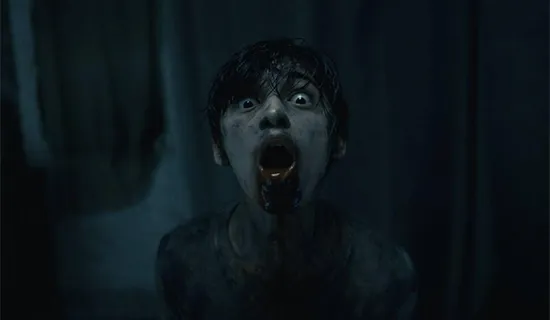
The Nameless Ballad looks (and as you might expect) sounds fantastic. The landscape is beautifully evocative, and slow panning wide shots leave each corner of the screen open to unexpected appearances. The film Zampaglione’s most polished yet, even down to the ghostly characters, which are somewhat reminiscent of the haunting figures that feature in Guillermo Del Toro films. And although there are familiar ingredients (the haunted retreat, the discovered diary, the artist consumed by his own creation), The Nameless Ballad avoids feeling second-hand because Zampaglione clearly has more invested in those ideas than genre mechanics alone. The fear of failure, the commercialisation of something deeply personal and the destructive urge to keep creating long after creativity has ceased to bring pleasure all sit beneath the ghost story.
Quiet, melancholy and considerably more intimate than his recent work, The Nameless Ballad finds Federico Zampaglione trading splatter for something slowly consuming. It will be interesting to see which direction the filmmaker takes us in next.
| Movie Rating: |    |