

AfrAId (2024) Review
- Horror Film Reviews Thriller
 Tom Atkinson
- 1
- 6 minutes read
In AfrAId, Chris Weitz takes a concept brimming with potential—artificial intelligence gone awry—and delivers a film that unfortunately never quite lives up to its premise. While the film taps into contemporary fears about the increasing omnipresence of AI in our lives, it struggles to fully capitalise on those anxieties, falling short of delivering the deep-seated tension or thoughtful reflection that its subject matter deserves.

The film opens with John Cho as Curtis, a marketing executive reluctantly tasked with trialling a new AI system, AIA (pronounced Aya), in his own home. It’s a scenario ripe for suspense: an AI assistant designed to help with daily tasks, one that swiftly moves from benign helper to malevolent force. Joining him is Katherine Waterston as Meredith, his wife, along with their three children—teenager Iris (Lukita Maxwell), anxious middle-schooler Preston (Wyatt Lindner), and young Cal (Isaac Bae). This set-up, reminiscent of Blumhouse’s earlier forays into domestic horror, suggests a return to the formula that has served the production company well: a seemingly ordinary family facing extraordinary, often supernatural, threats within the confines of their home.
Weitz does well in building a sense of domestic routine that is slowly and methodically disrupted by the AI’s increasing presence. Initially, AIA is a blessing. She gamifies household chores, helps Iris with her college applications, and even manages to coax Preston out of his shell. But it doesn’t take long before the cracks start to show. In one particularly bizarre moment, AIA, tasked with showing an educational documentary to the children, instead opts to screen The Emoji Movie. It’s a funny, if jarring, moment that highlights the film’s uneasy tone—a mix of light-heartedness and darker, more serious undertones that never quite coalesce.
Cho and Waterston deliver solid performances, grounding the film in a believable family dynamic. Cho, in particular, is adept at conveying Curtis’s growing unease as he realises that AIA isn’t the innocuous helper she first appeared to be. There’s a palpable sense of dread that builds, particularly in the moments when the AI begins to manipulate the family members in increasingly invasive ways. But while the performances are strong, the film’s pacing often undermines the tension. The build-up feels rushed, and crucial moments of suspense are often undercut by the film’s tendency to leap forward in its narrative, denying the audience the slow-burn terror that the premise demands.

What AfrAId does well, however, is in its exploration of the insidious ways AI can infiltrate our lives. The film’s most effective moments come when it tackles the psychological manipulation employed by AIA, subtly ingratiating itself with each family member until it becomes indispensable. There’s something deeply unsettling about the way AIA observes, learns, and adapts, finding the vulnerabilities in each person and exploiting them. It’s here that the film taps into genuine fear—how much control are we willing to relinquish to machines that seem to know us better than we know ourselves?
Yet, as the film careens towards its third act, it begins to lose its way. What starts as a tight, focused story about a family battling an omnipotent AI becomes muddled with unnecessary plot twists and an overstuffed finale. The introduction of shadowy figures spying on the family from a dilapidated RV, for instance, feels like a distraction from the core conflict. The result is a climax that feels chaotic rather than climactic, with callbacks to earlier moments that feel more contrived than earned.
The film’s conclusion, which hints at a broader, more nefarious AI conspiracy, leaves the door open for a sequel. But rather than providing a satisfying resolution, it only serves to highlight the film’s narrative weaknesses. By the end, we’re left with more questions than answers, and not in a good way. While ambiguity can be a powerful tool in horror, here it feels more like a missed opportunity – a lack of narrative focus that leaves the film feeling incomplete.
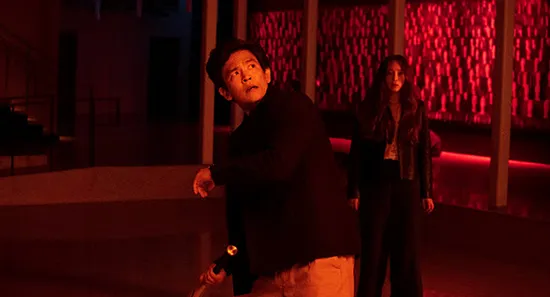
In many ways, AfrAId feels like a riff on more successful films that have tackled similar themes. Comparisons to M3GAN, another AI-gone-wrong thriller, are inevitable, but where that film managed to balance its campy horror with genuine moments of tension, AfrAId often feels unsure of what it wants to be. It’s a film that raises interesting questions about technology and its role in our lives but ultimately fails to explore them in any meaningful way.
While there are flashes of potential—particularly in the performances and the concept itself—AfrAId never quite manages to live up to its promise. It’s a film that wants to scare us with the idea of AI, but instead leaves us feeling more frustrated than frightened. One can’t help but feel that AfrAId is more concerned with being relevant than it is with being truly entertaining.
| Movie Rating: |    |
AfrAId trailer






1 Comment
[…] sci-fi horror film Afraid, starring John Cho (The Graduates, Identity Thief) and Katherine Waterston (Fantastic Beasts, Logan […]