
Interview: Lupita Nyong’o – ‘A Quiet Place: Day One’
- Interview
 Alex Humphrey
- 0
- 13 minutes read

When asked about his experience working with Lupita Nyong’o on A Quiet Place: Day One, Joseph Quinn’s admiration for the Oscar-winning actress is evident. “Conviction, compassion, fearlessness, decisiveness, Lupita embodies all these qualities.”
Nyong’o has been a prominent figure in the film industry since her remarkable debut in 2013 with Steve McQueen’s 12 Years A Slave, for which she won the Best Supporting Actress Oscar. Since then, she has demonstrated her versatility across multiple genres, including sci-fi as Maz Kanata in the recent Star Wars trilogy, family classics like Jon Favreau’s The Jungle Book, horror in Jordan Peele’s Us, and the superhero genre in the groundbreaking Black Panther series.
In A Quiet Place: Day One, Nyong’o revisits the horror genre, bringing with her the skills she honed on Black Panther: Wakanda Forever for some of the movie’s most physically demanding scenes. “I was fortunate enough to do some very intensive water training when I did Wakanda Forever. I brought that training to this,” Nyong’o says, referring to a signature sequence where her character, Samira, and Quinn’s Eric are trapped in a submerged NYC subway tunnel, pursued by bloodthirsty creatures as the water level rises.
“I was really excited to use my training again so soon,” Nyong’o smiles. “For Black Panther, I had to learn how to free dive and hold my breath for over two minutes. This training made me comfortable in the grimy, flooded subway setting, where navigating in the dark and holding your breath for long periods was essential to getting the shot quickly.”
Having lived in New York for about 12 years, Nyong’o was astonished by the authentic recreation of the city on the backlot of London’s Leavesden Studios by production designer Simon Bowles. “I was curious to see how New York would transform with the creatures’ invasion,” Nyong’o says. “The set was uncanny, and seeing it beautifully destructed was fascinating.”
Despite having experienced New York in near silence during the 2020 Covid pandemic, Nyong’o was still struck by the power of an NYC devoid of noise on the screen. “I actually lived through New York going silent,” she recalls. “In 2020, it was eerily quiet. I remember hearing birds I didn’t even know existed in New York. Walking through an empty Times Square was surreal. But A Quiet Place: Day One takes that to another level, as sound itself is the enemy.”
As a fan of the original films, Nyong’o is confident that fans will be thrilled with the new instalment. “This movie is so amplified,” she teases. “We’re no longer on a farm in the middle of nowhere. We’re in New York City, with its multitude of people and noises. There’s a lot going on.”
With a cast and crew dedicated to delivering an epic and immersive prequel, A Quiet Place: Day One promises to expand the terrifying world of its predecessors, leaving fans eagerly anticipating its release.

Lupita Nyong’o Interview
Joseph Quinn says that you and he became good friends on this movie. When did you guys start to hit it off?
“It was on the first day. Day One. I remember, we were waiting for a set-up. I’d been working [on this movie] for a bit before he started, so he had that nervous [first day] energy. But I knew we were going to be good when he just sat by me and asked me a bunch of questions, about my life, my career, and how it was all going. He was so open and curious. Straight away, I said to myself, ‘Yeah, this is going to be good.’ Later that day, while filming together, he came with the best energy and made bold choices – every take was different. I thought, ‘Oh, not only is he a great person, he’s also a fantastic and generous actor. This is going to be a blast because all I have to do is just show up and be in the scene with him!’ Not every actor is that generous. But Joe was. I knew right away we were going to be good on set – and also great off it.”
What can you tell us about Samira and Eric’s relationship in A Quiet Place: Day One?
“Samira is a woman who comes to New York City on a day trip, on the day the world changes for the worst. She is forced to navigate a city with very different rules. Along the way, she meets an unlikely and perfect stranger in Eric, who she reluctantly has to work with, to figure out how to survive.”

So lets talk about the early part of the film. What happens in that initial attack sequence, and what was it like to film it?
“It was painstaking work, so many moving parts. It’s very choreographic. The scale of this movie is so amplified. We’re no longer on a farm in the middle of nowhere [as in the original]. We’re in New York City, and that’s a lot of people, a lot of noises. There’s a lot going on. Everything has to be in sync. It was tough, but also so exciting. The set was fabulous. And we watched it get destroyed. At first, it’s New York – and it’s pristine, all the chaos, all the beauty. And then, of course, everything changes when the creatures land. The work that [production designer] Simon Bowles did was amazing. And to have that destruction, that real change happening around us, really helped to support our performances.”
How would you describe what audiences can expect from this film?
“Here’s the thing: the first two films follow characters in rather remote environments, where the elements are a little easier to control. But now we’re coming to this story on the first day of the attack, when nobody knows the rules of this new world. And we’re coming to it in one of the busiest cities in the world. It will give audiences a sense of what happens when a city like New York has to fall silent. It’s hard to imagine, but we’re going to help you out with that!”
What part of the film were you most excited about shooting?
“I was really curious to see how New York would shift as everything changes with the creatures’ invasion. What was great was that we had to shoot the attack sequence in sequence because we were using a set that had to be destroyed. To see that set was uncanny. I lived in New York for about 12 years, so I’m very familiar with it. The detail that went into everything, from the fire escapes to the trash cans, everything was so real. To then come the next week and see it so beautifully destructed was fascinating, the detail in the scratches on the buildings, destruction everywhere. It was so compelling.”
You have lived in New York previously, how did you find the idea of seeing a silent New York?
“I actually lived through New York going silent. In 2020, New York went pretty darn silent [in the Covid pandemic]. It wasn’t A Quiet Place: Day One levels of silent, but it was spookily quiet. I remember waking up and being able to hear the birds. I didn’t even know New York had birds! I knew there were the pigeons that pester you. But other than that, I was not aware that we had birds! And in 2020, you would hear the birds and the wind whistling through the leaves. It was unbelievable, walking through Times Square with not a single person in sight. I remember that. A Quiet Place: Day One is that times a thousand. Because sound is the enemy.”

Can you tell us about the dramatic subway sequence that we’ve been hearing lots about?
“As I’m sure you can imagine, there’s a lot of running that has to occur in order to survive an alien invasion. A big attack sends Sam and Eric to the subway and since the subway has flooded, they have to figure out a way to escape these creatures through the flooded subway system. And things are made more complicated because, of course, Sam has a cat and cats do not like water. She has to figure out a way to keep both of them safe, and to stay close to her new companion, Eric.”
How did you deal with having to shoot a sequence where you were in water for long periods of time?
“I was fortunate enough to do some very intensive water training for Black Panther: Wakanda Forever. I brought that training to this. In fact, I was really excited that I got to use my training again, so soon. It was very, very helpful. One of the things I had to do for Black Panther was learn how to free dive, to learn how to go super deep and hold my breath for over two minutes. It made me very comfortable on this because you don’t ever want to be swimming through a flooded subway, because it is grimy. They did a great job of making it seem grimy without making it a health hazard! But it means you have to navigate in the dark and hold your breath for long periods, to be able to get the shot quicker, so my training came in handy. I’ve also done training with weights underwater, so I could handle all the clothing and extra weight that Sam carries as well.”
What are your favourite moments from the previous two A Quiet Place movies?
“What I loved on those is how little you saw the creatures. Especially in the first film. In that, your imagination is doing most of the horrifying work. It’s so tense and the performances are so brilliant that as an audience you find yourself right in their perspective. And then there was the baby in the cradle! Excruciating! That and the birth scene. In that you are very, very viscerally in that mother’s body. I really appreciate that.”
How much are we going to see of the creatures in this movie?
“I would say that now we have met the creatures… [Laughs] Let me say that we learn more about the creatures in this movie. Is that enough of a tease?”
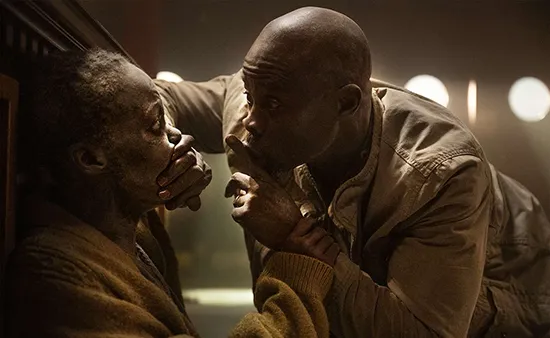
It was great to see Djimon Hounsou returning from A Quiet Place Part II. What does he bring to this movie?
“First of all, it was great to have that connective tissue [Hounsou plays the leader of the survivors on the island in A Quiet Place Part II] between the movies. And I have been an admirer of Djimon’s work for a long time. To be able to meet him and share the screen with him and work beside him and opposite him was a dream come true. It did not disappoint. Nor will it on screen!”
You can see A Quiet Place: Day One exclusively in cinemas from 27 June.
A Quiet Place: Day One trailer