
The Devil From Mill Mountain (1955) Review
- Horror Film Reviews
 Darren Gaskell
- 0
- 6 minutes read
In the Middle Ages, the greedy owner of a windmill farm bands together with a local castle’s steward and a shady associate to destroy a rival mill in a nearby forest. Disguised as devils, they steal the flour from the forest mill before burning it down. Subsequently, the farmers of the area agree to have their grain ground at the nearest mill, which happens to be that of the evil miller. Anne, a farmhand, suspects foul play and takes a job at the windmill farm in order to get to the bottom of the mystery…
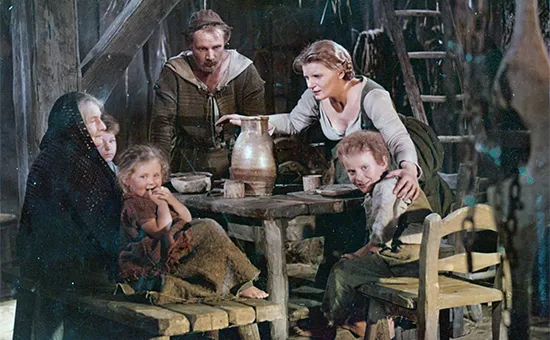
DEFA (Deutsche Film-Aktiengesellschaft) was the state-owned film studio of the German Democratic Republic, producing cinematic output which was intended to rival Western movies in terms of production value while stressing a socialist realism aligned to the GDR’s Communist principles. DEFA made movies across a number of genres and their fairytale output tends to be notable because of one particular title, 1957’s The Singing Ringing Tree, which was purchased by the BBC, dubbed into English and immediately established itself as nightmare fuel for a generation.
The Devil From Mill Mountain is a more straightforward, less bizarre outing than The Singing Ringing Tree but that’s not to say it doesn’t possess its own set of quirks, most notably three giant spirits called The Good Charcoal Burners who guide our salt of the earth heroes on their quest. The trio intervenes only when absolutely necessary, because when you need to seize the means of production there’s nothing more rousing than a workers’ uprising. However, when they do intervene, it’s in an abrupt, odd fashion.
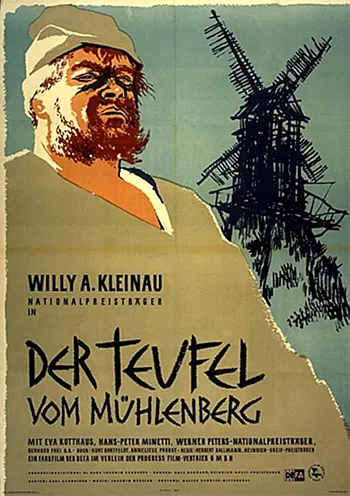
As much as there’s a “capitalism bad, communism good” undertone to all of this, it’s rarely overplayed and the classic fantasy tropes of good versus evil are dealt with in a familiar way which puts story and spectacle first, politics second. It also features a smart, resourceful female protagonist in the form of Eva Kotthaus’ Anne, decades before it finally became fashionable for Western movies to have women driving the plot, kicking arse and taking names. Yes, there’s a romantic interest of sorts in Jörg, played by Hans-Peter Minetti, and yes, he does rescue Anne at one point but there’s no suggestion that Anne is in any way inferior to her male counterparts. In fact, she’s the one carrying the bulk of the responsibility and Jörg is relegated somewhat to being the occasional brawn of the enterprise.
This screening at Culture Shock 2026 was probably the first time a UK audience had seen this in a cinema and, the privilege of viewing something that had not previous seen the light of a projector on these shores aside, The Devil From Mill Mountain turned out to be a charming, Eastern European spin on timeless fable territory, where the scary monster is revealed to be the corrupt acquisition of wealth but there are also bad guys to boo and good guys to cheer.

The excellent set designs and costumes add to that otherworldly feeling and much of the humour translates surprisingly well, going for broad but not clumsy strokes and relatable panto style slapstick. There’s a reliance on triumph through community rather than superior resources or firepower, although The Good Charcoal Burners provide their own, climactic, deus ex machina chicanery when all seems as though it’s about to be lost. Does it undercut the ideology of the piece? Yes. Were we waiting for The Good Charcoal Burners to flex their powers? Of course. It’s an unexpected swerve, but it’s a flight of fancy about competing mills in a fictional land hundreds of years ago, so I don’t think it’s possible to get too worked up about it.
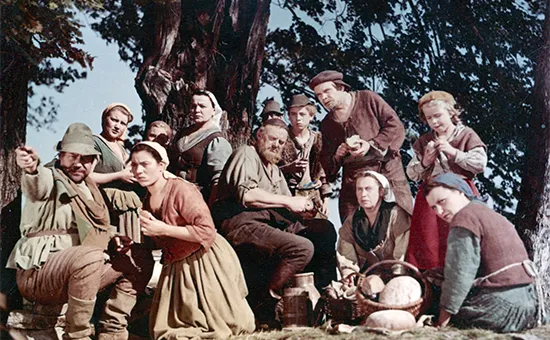
The Devil From Mill Mountain is a fascinating glimpse into what movie audiences behind the Iron Curtain were seeing and, in the case of DEFA’s slate, it wasn’t a million miles from what was sending Westerners flocking to the fleapits. The filmmaking techniques and some of the performances may be showing their age seventy years on but that can be said of most 1950s titles and, given the fantastical setting, this one hasn’t dated anything like as badly as you might expect. Okay, so Herbert Ballman’s movie may creak as much as the forest mill’s water wheel in a few places but it’s handsomely constructed, consistently entertaining and shows an appreciation of detailed female characterisation that leaps and bounds ahead of its Hollywood equivalent.
| Movie Rating: |    |
The Devil From Mill Mountain trailer