River (2023) Review
- Horror Film Reviews
William Knowles
- 0
- 6 minutes read

Very few narrative devices feel like they have exploded in global popularity and potential across all mediums quite like the time loop. The idea of infinitely reliving the same moments on repeat has proven to humorously be near infinite in its possibilities. From video games like Nintendo’s Legend of Zelda: Majora’s Mask and Bethesda’s Deathloop, to Hollywood successes like Groundhog Day (1993) and Edge of Tomorrow (2014), writers and filmmakers have utilised the device to explore their respective work’s themes.
Junta Yamaguchi’s River (2023) is a refreshingly intimate and immersive approach to a time loop that is led by its’ strong central cast of characters. With a premise as cosmic in scale as time itself, there will be a natural inclination to go large scale in a film but as River proves bigger does not mean better.

From the opening frames, audiences immediately find themselves venturing into Kibune, a sleepy Japanese village just barely populated by the old Fujiya Inn, wherein they’ll remain for the next eighty six minutes. River is not a film concerned with the science behind a time loop, the geographical implications and whatnot, it is a film about the Inn’s residents and their fear of change.
The entirety of the film is built more so around this fear of change than the time loop itself which while in the film is the cause of a supernatural phenomenon, in reality is a narrative expression of the common desire for a status quo.
To say modern society, is overrun by nostalgia is an understatement. In 2023 alone according to Box Office Mojo, the top nine films have all been based off pre-existing properties or sequels. It can often feel like we are stuck in a state of complacency, never wanting to change. This certainly not a novel claim, in the current climate but is a mantra that is relevant to River, which champions the beauty of change and progress.
The apparent catalyst for the time loop, is the wish of employee Mikoto to the river god for time to stop, symbolised by the titular river’s flow stopping. As the film progresses, Yamaguchi primarily analyses the deeper facets of her character, we may get occasional scenes focusing on the side characters’ reasoning for wanting time to stop from work deadlines to family struggles, Mikoto acts as the lens into the Inn’s time loop.

From the start of every two minute loop, the camera always returns to align audiences with Mikoto by the river, psychologically always adjusting us to the loop and her perspective. The two minute loop is dramatically shorter than the repetition present in other examples of the device, a novelty which Yamaguchi expertly exploits for creative potential. Besides, strong concise writing which outlines the strong personalities and backstories of its’ characters and the editing that situates the audience directly into the loop every few minutes, Yamaguchi never cuts away to a few loops ahead. Each loop is shown giving the film the rare ability to travel at real time meaning that not only do the cuts back to the loop’s start give the illusion of being immersed in this struggle but now with the real time pacing it is an actuality, a testament to the creative power of editing and cinema.
The film’s tone similarly is praiseworthy, juggling light hearted comedy and drama in a natural blend that never reaches immersion ruining absurdity or so serious that it undercuts the humour. This due to again, the screenplay’s strong character writing, all comedy and drama come from the natural interactions of characters straddling a line between comedic archetypes and a sustainable level of depth. Despite the possible corniness, a very light tone could generate, it never feels like the film sugarcoats itself and can’t appeal to all audiences. As a matter of fact, the ultimate hopefulness is a much appreciated palette cleanser to the abundance of cynicism in many modern films.
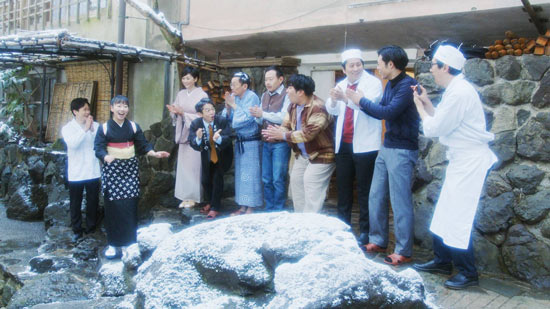
This was what mainly gravitated me towards River. The ability for a film to convey such a personal sentiment about why change must not only be necessary but fostered, spoke to my own thoughts on the current state of the world. Much like Mikoto, many audience members will be hostile to change in favour of a comfortable status quo, but seeing the existential agony that a life without progression causes and the joy that can the characters experience by overcoming anxiety and pursuing their future wants will be sure to resonate.
The time loop device may have become grating for the more jaded of audiences, but River is an example of how the concept can be utilised in conjunction with the theories of filmmaking to capture the distinct moods of audiences rather than act as a simple gimmick. A must watch for those seeking a narratively experimental film with relevant substance and a great exercise in creativity and entertainment.
| Movie Rating: |   |
River trailer: