Pathetic Fallacy (2026) Review
- Horror Film Reviews Psychological Thriller
 Darren Gaskell
- 0
- 6 minutes read
Asher (Kid Cudi, credited as Scott Mescudi) and Iris (Jessica Rothe) are a happily married couple forced to deal with a devastating turn of events as Iris finds out that she is terminally ill. In the final moments of her life, Iris has requested that Asher should read a special meditation text which is meant to provide him with some semblance of clarity and comfort while paving the way for her soul to move on to the next plane. In the days afterwards, it’s clear that Asher has not taken any comfort at all and his outburst at Iris’ funeral suggests he may never get over the loss.
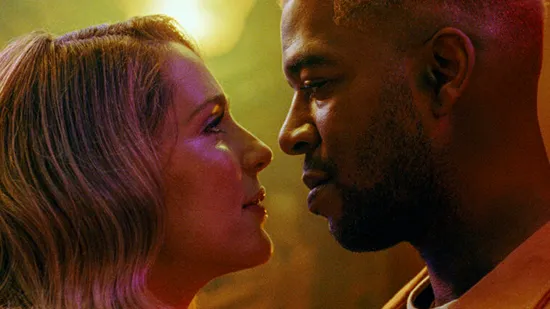
In a haze of tuning out from his daily life, save for assaulting an annoying customer at his place of work, and wandering the city’s streets aimlessly, Asher begins to notice various references to a place called Mount Samdi, a town in the mountain which promises an unnatural, planetary energy focus which could go some way to healing Asher’s broken heart. With little more to lose, Asher travels to Mount Samdi and a chance encounter which may be nothing of the sort reveals that there may be an opportunity to regain what he has lost. However, that comes with a hefty price…
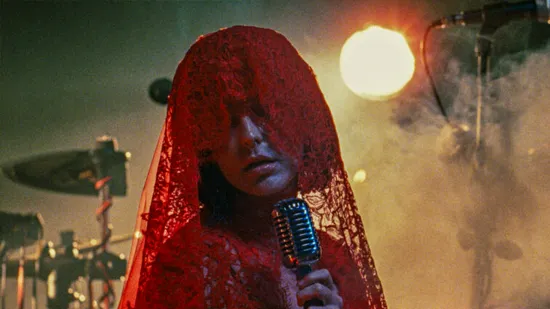
The first of Celluloid Screams’ Secret Films for 2026, Adam Egypt Mortimer’s Pathetic Fallacy sets out as a heartbreaking study of loss – brace yourself for the lengthy scene in which Iris’ life slowly ebbs away and Asher howls long and loud into the bedsheets – but then swerves into something much, much weirder as Asher refuses to believe that death is the end and confronts his own limits as to just what he is prepared to do to get his wife back. People die quickly, unexpectedly and nastily. Oh, and it’s also a musical, featuring evocative electronic tunes from Johnny Jewel.
The title’s origins in literature denote the attribution of human emotion and behaviour to things non-human which are found in nature and there’s plenty of that here, as a persuasive, mind manipulating spider (voiced by Natasha Lyonne) pulls on Asher’s threads and explains the diminishing routes out of his increasingly sticky situation. Elsewhere, woodland creatures, some voiced by indie titans Justin Benson and Aaron Moorhead, argue as to the suitability of Asher for the tasks at hand, their red eyes cutting through the night to remind all those wandering into their territory that you are, indeed, being watched.
The inclusion of Benson and Moorhead is a canny one and the contained but unstable enclave of Mount Samdi recalls both Resolution and The Endless. However, if you thought those locations were odd and full of unreliable actors, be prepared for an entirely different level of bonkers here. Travis Fimmel, as a local who befriends Asher at a bar and offers him a place to camp in the epicentre of the cosmic copse, seems like a nutter and a murderer from the start which points matters in the direction of a second half battle of wits between the two before precisely none of that happens and you’re left wondering just how many metaphorical rugs have been slid under your feet to be pulled out later.
The writing team of Andrew Barrer and Gabriel Ferrari were previously involved in Ant-Man And The Wasp and Transformers One, to name but two, so they have form for putting an offbeat spin on what would otherwise be multiplex material. Their latest screenplay pushes all of that weirdness to the limit, mixing romance, psychedelia and brutal violence into a heady cocktail which I would suggest will intoxicate the viewer or give them a blinding headache and a need to leave the room.
It’s likely that the sudden shift from suffocating portrayal of grief into an oblique, backwoods serial killer thriller may lose some folks but it’s these audaciously big swings that kept me gripped and wondering where the tale – and by dint of that, Asher – would travel to next. Each time, I was wrongfooted. Despite being driven by rage, Asher’s path is far from a straight line of possible victims and the collateral damage which seemed inevitable switches into a battle of wills between him and a forest full of impatient critters before the final act which throws in a face from the past – or does it?
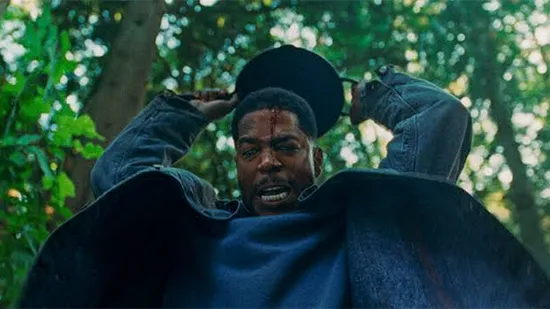
In his film debut, Mescudi is excellent, showing impressive range whether his character is devastated or deranged and playing the blackly comic moments with a deadpan style. Rothe is, as ever, brilliant and continues to be one of the standout performers of the horror genre. What the hell, let’s make that any genre. As a couple, they’re utterly convincing and it’s a wrench to see them torn apart in that first act but it’s intriguing to see how, or if, Iris will return. Both Mescudi and Rothe get to do some crooning – you’d be mad to squander a chance to get Kid Cudi throwing down some karaoke – but it’s Rothe who gets more vocal time including one of the most startling and angry singing performances you’ll have heard in a while.
Not so much a genre-hopper as a project which leaps across boundaries with abandon, Pathetic Fallacy is a beguiling, bewildering mix of the fanciful and the frightening, the goofy and the gruesome. It looks beautiful too, shot in warm 35mm and with sumptuous visual effects, upon which Adam Egypt Mortimer imposed one rule and one rule only upon: there was to be no AI used in their generation. Excuse the profanity but fuck yeah, which is also a fine two word summary of my feelings about this movie. It’s divisive for sure, but I did not want it to be over and I expect it to be in my Top Ten come the end of 2026.
| Movie Rating: |   |