

Candyman (1992) Review
- Monsters
MadWomanInTheAttic
- 3
- 10 minutes read
 Picture the scene. Its late at night, you’re stood in a bathroom, in front of the mirror. Repeat after me: Candyman, Candyman, Candyman, Candyman… nope, can’t do it.
As much as it seems silly, the power of what might happen still scares me (and the fact that once I did complete the incantation, after watching the film for the first time, and the lights went out. Really. I’m not joking).
In the spirit of full disclosure, I think I should start by saying how much I love this film, and not just how much I love it, but how interesting and complex it is. It’s the kind of film that I get more from each time I watch it. In fact, even writing this review is making me want to watch it, again. Who said the 90’s was a bad decade for horror?
Helen (Virginia Madsen) is writing a thesis, with her friend Bernadette (Kasi Lemmons) on urban legends at the University of Illinois.
She hears about the Candyman legend – a violent killer with a hook for a hand – from a couple of the  university’s cleaners, and upon further research traces an interesting connection between the Candyman story, the infamous African-American housing projects at Cabrini Green (a real-life place, where some of the film was shot), and her own more upmarket apartment.
Emboldened by these connections, and the desire to get one over on the arrogant male academics in their department (one of whom is Helen’s husband, Trevor – clearly a rather lecherous lecturer), Helen and Bernadette go to investigate Cabrini Green.
On this initial visit they find a great deal of graffiti and an initially stand-offish resident who repeats the Candyman legend told to Helen by the cleaners.
As Bernadette becomes increasingly nervous, Helen later returns to the projects on her own, where she meets a young boy who tells her another version of the story. He takes her to the site of a supposed attack and Helen is cornered and badly beaten by an African-American gang, the leader of which claims to be Candyman.
Thinking she has de-bunked the myth and solved the crime, Helen is comforted by Bernadette’s news of publisher interest in their research. At this point, she is paid a visit by the much more scary, and certainly less human Candyman (Tony Todd), who informs her that she has come between him and his congregation and invites her to be his victim. From here on, Candyman’s violent actions seem to the outside world to be perpetrated by Helen and her life spirals out of control. Eventually placed in a psychiatric ward, Helen must return to Cabrini Green one last time…
 There are three main aspects of the film which I am going to pick out, but really it is the complexity of how things are handled and the dramatisation of the connections between worlds, the differing articulations of the stories about the monster, which make it so interesting. That it is also genuinely scary helps a great deal too.
Firstly, Virginia Madsen’s Helen is a well drawn heroine. She is both engaging (there are plenty of moments in the film where we empathize with her, or feel strong anxiety for her) and at the same time flawed, particularly through her academic arrogance (not seeming to realise that having graffiti plastered all over your door might be less than ‘great’). She is a satisfyingly developed addition to the women that populate horror films, her investigativeness, apparent madness and victimhood are handled in ways that present her as a fully fleshed-out character. Madsen’s performance perfectly manages this balance. The relationship between her and Candyman further allows Helen to be a sophisticated creation, and I think there is something fascinating about the way in which his presence hypnotises her. Through this she seems to become a sleepwalker, a figure familiar to the horror film, but not merely a passive automaton as demonstrated by the ending. There is a great deal of power in the scenes where Candyman has this effect on her, not least because Madsen was apparently hypnotised for real by the director Bernard Rose (you can see the difference in her eyes, which become dilated and bloodshot, making this claim seem true).
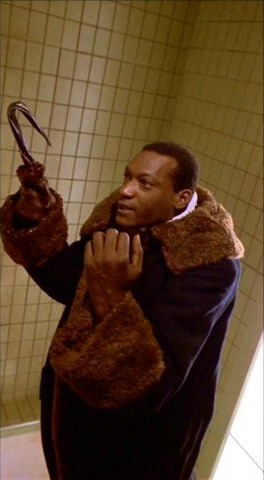
Secondly, Tony Todd’s Candyman has to be one of the most powerfully realized horror monsters ever, and Todd’s performance is absolutely part of this, his physical presence and poise is magnetic. The way in which his body is presented constructs a monstrous figure with great complexity.
Candyman’s bloody stump does not just remind us of his threatening physicality that promises brutality and makes us fear for Helen’s own vulnerable body, but it also significantly indicates Candyman’s own victimisation and thus our sympathy for him. Part of his history, retold early on by Professor Purcell, is that he was tortured and killed for falling in love with and impregnating a white woman – during which his hand was sawn off . Through his physical deformity he bears the markings of violence done to him and thus his physicality and the way it is presented foregrounds violence and suffering, monster and victim.


This layered approach to the monster leads me to the third aspect: representations of race. Candyman significantly marks the introduction of an African-American monster to the horror mainstream, and the ways in which it articulates race and racial divides is particularly striking.
As well as combining a threatening physical presence and gruesome method of attack, Candyman seemingly offers an embodiment of racial stereotypes based on fears of miscegenation. Thus, the way race and racial divides are represented by the film is specifically important to the construction of a monster who is afforded invisibility by the black community’s fear of him and is then made visible again by the intrusion of a white woman.
 Through Todd’s performance Candyman appears dignified, charming even. His voice, whilst still unnaturally deep, gradually softens and becomes seductive, his language refined. The details of his costume, which include a white cravat and the fur-trimmed coat, accentuate the distinguished aura his quality of movement and physicality gives off, making him appear more like a dandy than a monster. As such he offers a stark contrast to the African-American working-class as depicted in the film so far. In this way, blackness, like whiteness, is not presented simplistically. Indeed, Helen’s own oscillations between heroine, victim and monster equally confound the rigidity of the white feminized ideal.
Candyman is also one of those rare things, a film adapted from a short story (by Clive Barker), that is better than the writing it is based on. That’s not to say that Barker’s story is not interesting in its own right, but the film expands the directions taken by the story in vital and involving ways.
Miles away from the low budget end of many a horror film – the score is composed by Philip Glass for goodness sake – Candyman is a thoughtful piece of work, with its pleasures still very much grounded in the materiality of horror.
Movie Rating: 
Additional film information: Candyman (1992)
Trailer:


3 Comments
[…] you brave enough to say Candyman five times in a row? When the original Candyman movie was released in 1992, it quickly became a contemporary horror classic. Despite two previous […]
[…] Candyman was adapted by Bernard Rose from a Clive Barker novel. Rose made the wonderful choice of transposing the original story from Liverpool England to Chicago US and it is, in my opinion, what makes it so profoundly affecting. Rose reimagines the Candyman as a projection of the urban ills, an urban legend that is born from the social inequities and the everyday social violence of poverty and Urban dereliction. What I love particularly about Candyman is that it is one of a handful of films that can genuinely pretend to be pure “Fantastique”, in that its fantastical nature is preserved to the end. Each scene casts a doubt as to whether Candyman is real or a pure invention of Helen Lyle’s disturbed mind. Candyman only appears to her reality after she is violently assaulted and hit in the head, he appears only to her and she is consistently alone with the victim when Candyman’s violence erupts into frame. Candyman is a confrontation of opposites, with reality and myth being but one of the many concepts the film chooses to mirror. It’s also a film that understands that theme and form are inseparable, they exist together or not at all. The idea of the boogieman existing in a mirror is carried through every level of the film, Cabrini Green a mirror image of Helen’s gentrified apartment complex, Helen herself is the mirror image of Daniel Robitaille’s long lost love (which launches the film into the Gothic realm, bit more on that in a bit) and as Tony Todd himself put it to the Telegraph in 2024: “The Candyman is a living, breathing mirror. That’s why mirrors are so prominent in the story. You shouldn’t see a black bogeyman… there’s no such f–cking thing! What you should see is the rage, the stigma, and the hatred people have for something that should have been welcomed. The character mirrors all of that”. […]
[…] deal of horror, but films that genuinely unsettled me, I found quite rare. I loved the original Candyman, for example, though I’m not sure it truly unsettled me. That feeling perhaps came later, with […]