
Black Sunday Confessions – Adrian Tofei and Duru Yücel of ‘We Put the World to Sleep’
- Interview
 Peter Campbell
- 0
- 10 minutes read
What happens when a performance refuses to end? That’s the unsettling question at the heart of We Put the World to Sleep, the ambitious new feature from husband-and-wife filmmaking team Adrian Tofei and Duru Yücel.
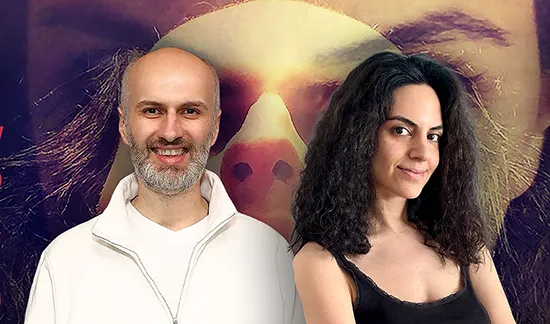
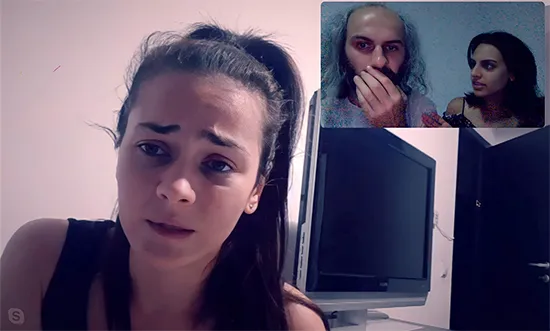
Screening today at Black Sunday Film Festival‘s Midsummer Scream, the film follows two performers who become so consumed by the apocalyptic characters they’re portraying that fiction begins bleeding into reality, sending them on a mission with potentially catastrophic consequences. Equal parts psychological horror, experimental cinema and philosophical thought experiment, it has already earned acclaim on the international festival circuit, collecting awards for Best Midnight Feature, Best Director and Best Found Footage while drawing comparisons to some of the genre’s boldest and most unconventional work.
The second chapter in Tofei and Yücel’s planned spiritual trilogy, We Put the World to Sleep builds on the fearless filmmaking that made Be My Cat: A Film for Anne a cult favourite, while carving out an identity all of its own. Developed over almost a decade and shaped from around 150 hours of largely improvised footage, it’s a film that challenges audiences as much as it unsettles them.

For this edition of Black Sunday Confessions, we sat down with Adrian and Duru to discuss their latest collaboration, the films that shaped their creative journeys, dream collaborators, recurring nightmares and why horror works best when it leaves you with more than just fear.
Adrian Tofei (writer-director and star) and Duru Yücel (writer and star)
1. Tell us about your film and what brings it to the Black Sunday Film Festival.
Adrian & Duru: Well, it’s the second part of our spiritual trilogy – and the “spiritual” stands for both the way the films are connected (loose connections, “in spirit”) as well as for the way the trilogy works: a voyage from the lower self (Be My Cat: A Film for Anne) to the middle rational self (We Put the World to Sleep) to the higher self – mysteries beyond reason (our upcoming feature Pure – currently in pre-production). We’re happy to be having been invited to screen at the Black Sunday Film Festival, and hope that people will enjoy the movie and maybe even come on board for Pure, as we’re currently open for more investors/producers!
2. What moment made you realise you wanted to create films, not just watch them?
Adrian: There were two moments. First came in my teenage years, when I caught a scene from 2001: A Space Odyssey on TV. I remember being absolutely taken by it, I froze in place in front of the TV, the hair on my back went up, it was one of the greatest revelations in my life, for the first time I understood that film can be such a deep and powerful form of art. And the second one came years later when I made a connection between the Romanian acting method I was studying (Ion Cojar’s method) and the revolutionary “method filmmaking” used by the creators of The Blair Witch Project.
Duru: I’ve always been a true cinephile, but when I was nine, I decided to devote my life to theatre. Although I was trained in theatre as a young adult, after working professionally for a short time, I came to a point in my life where I realised that when it came to engaging with it as a performer, my love for cinema grew while my love for theatre faded away. So, after 28, it was clear that I was going to invest myself in film both as an actress and as a writer, since I have also always had a literary bent and a deep interest in storytelling in its written form.
3. What was the first film that truly unsettled you?
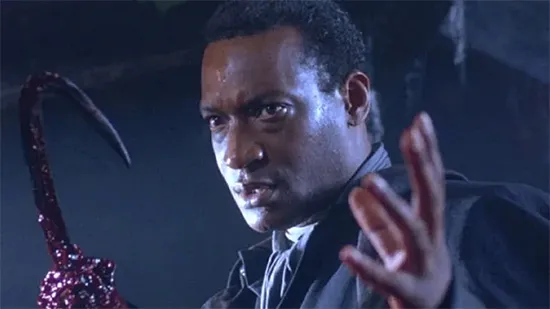
Duru: I still remember funny memories from when I was around seven years old, with all those feelings completely intact. I used to watch A Nightmare on Elm Street sometimes, and make everyone else get out of the room and used to turn the lights off so that I could just laugh out loud by myself all the way through. I found the movie funny in all the best ways, so that was the unusual bit of my first engagement with the horror genre. What truly unsettled me came later. I was 11, visiting my aunt in Cardiff during the summer Lady Diana died, and Candyman was playing on TV. I remember how impactful its visual language was. I couldn’t even speak or even understand a bit of English back then but it made me unable to even use the bathroom at nights without leaving the door open for the rest of our stay. Candyman lingered in the darkest corners of my psyche for a long time, but thankfully I’m rid of it now for a long time, haha.
Adrian: If there’s nothing positive coming from being unsettled by a movie, then I see no value in the movie being unsettling. Otherwise we could all watch shock videos with real murders, tortures and extreme human suffering, the way I was sadly and morbidly curious to watch many years ago, get extremely disturbed to the point of PTSD and deeply regretting afterwards. That’s why I’ll mention instead a film that truly unsettled me not in general, but in a clearly positive way: The Night House (2020).
4. Who would be your dream collaborator, living or dead?
Adrian: I arrived at a point in my career where I got tired of acting in my own movies, it’s taking a toll on me to live in character for months before shooting, also produce, write, promote, raise a budget, cast, direct, do the camera work, the sound, film editing, and all these will full on “method filmmaking” immersion that takes over my entire life. I’d love to act in other people’s movies and deal with just my acting and living in character, nothing else. Ideally with filmmakers who appreciate my previous work and I appreciate theirs.
Duru: For me, it’s Lars von Trier without a doubt, but only as an actress, because I truly crave to be in one of his films! Dogville is one of my top three movies of all time; I believe it’s brilliant. So, anyone reading this, please help me get in touch with him, haha. If the question refers to horror only, I’d say Alejandro Amenábar because he directed The Others, one of my favourite horror movies.
5. If your worst fear became a film, what would it look like?
Duru: It mainly has to be centred on getting tattooed on the face. That’s my recurring nightmare, and it’s always some little stars tattooed on my face. Thankfully, I only happen to have it three times a year at most.
Adrian: I’m not sure what my biggest fear is – maybe homelessness? But I wouldn’t know (yet) how to make a movie about that, it’s one of the most horrific fears and tortures inflicted on people by all the political systems telling us: “Hey, don’t take risks following your talents and feeding the spirit, just struggle to make ends meet with a day job at McDonalds and a night job at OnlyFans, otherwise you’ll end up miserable on the streets.” I wouldn’t want to contribute to that fear which forces people into modern-day slavery and spiritual bankruptcy, unless there’s an angle which could potentially free them from the fear.
It’s clear that We Put the World to Sleep is the product of filmmakers who see horror as something far more expansive than scares alone. Whether discussing philosophy, performance, the boundaries between actor and character or the films that continue to haunt them for the right reasons, both share a genuine passion for using cinema to explore difficult questions rather than simply provide easy answers.
That creative curiosity has already helped establish We Put the World to Sleep as one of the most talked-about independent genre films of the past year, and with the final chapter of their spiritual trilogy, Pure, now in development, it’s evident that Adrian Tofei and Duru Yücel have no intention of taking the conventional route.
We’d like to thank Adrian and Duru for taking part in Black Sunday Confessions, and wish them every success with We Put the World to Sleep as it continues its festival journey and reaches new audiences around the world.
We Put the World to Sleep trailer