
Schlitter: Evil In The Woods (2023) Review
- Horror Film Reviews Psychological
 Tom Atkinson
- 0
- 6 minutes read
Pierre Mouchet’s Schlitter: Evil in the Woods presents itself as a lean and mean slice of rural horror, set against the misty, brooding backdrop of the Vosges mountains in Eastern France. From its very title, Schlitter—referring to a rudimentary and dangerous wooden sled once used to haul timber down steep slopes—the film hints at a descent into something dark and unmanageable. What begins as a tale of childhood trauma rapidly spirals into a brutal narrative of vengeance, guilt, and the inescapable grip of the past. But does Schlitter manage to stay on track, or does it careen out of control?

The film opens with a gripping sequence that immediately sets the tone. Young Lucas (Antime Calbrie Ekeloo) is introduced as a boy struggling under the weight of both a literal and figurative burden. Tasked with controlling a schlitter laden with logs, Lucas fails and earns the wrath of his brutish father, Louis (Bernard Eylenbosch), who is quick to discipline him with a slap. It’s a scene that succinctly encapsulates the film’s central theme: the unrelenting and often cruel forces that drive individuals, whether it be gravity or the oppressive hand of an authoritarian parent.
From here, Mouchet wastes no time plunging us into the central trauma of the story. Lucas’ best friend, Mathias, is tragically killed in an accident caused by Louis. The father’s callous decision to cover up the incident and his insistence that Lucas remain silent sets the stage for a tale of retribution that will unfold decades later when Lucas, now an adult (Louka Meliava), returns to his village after the deaths of his estranged parents.
It’s in these later scenes that Schlitter aims to build on the tension established in its opening act. Lucas returns home, bringing with him his pregnant girlfriend Julie (Léna Laprès) and his best friend Arnaud (Côme Levin), only to find that the past has not been buried as deeply as he might have hoped. Mathias’ father, Francis (Gilles David), now a wheelchair-bound widower, has spent the intervening years festering in his grief and planning his revenge. What follows is a series of cat-and-mouse games through the dense forests, with Mouchet drawing clear inspiration from films like The Texas Chain Saw Massacre and Don’t Breathe.
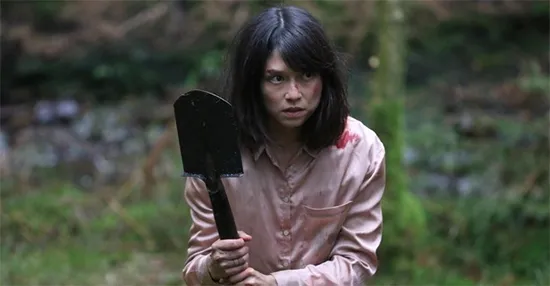
Where Schlitter excels is in its atmosphere. The Vosges forest is rendered in rich, damp detail by cinematographer Nicolas Beauchamp, whose work captures the oppressive and haunting beauty of the setting. The forest is almost a character in itself—alive with the echoes of past sins and the specters of vengeance. It’s a place where the line between the living and the dead feels perilously thin, and where the natural world seems to conspire in the violence that unfolds.
Mouchet’s direction is confident in these moments of tension, as he skillfully manipulates the audience’s expectations. The early half of the film is peppered with red herrings and moments of quiet dread, leading the viewer to anticipate the inevitable explosion of violence. When that violence does come, it’s both brutal and cathartic, though not without its own complications. The use of practical effects is commendable, adding a sobering edge to the proceedings that will satisfy fans of gore without tipping into the realm of excess.
However, as much as Schlitter captivates with its mood and setting, it falters in its storytelling. The narrative, though initially engaging, begins to unravel as the film progresses. The script, co-written by Mouchet and Nicolas Robin, introduces intriguing psychological elements—such as Lucas’ nightmares and his possible psychic connection to Mathias—that are ultimately abandoned in favor of more conventional slasher tropes. This choice leaves the film feeling somewhat shallow, particularly in its latter half, where the plot’s momentum stalls and the characters’ decisions become increasingly driven by genre conventions rather than organic development.
The character of Julie, in particular, is a disappointment. Despite an early attempt to establish her as more than just a damsel in distress, she ultimately falls into that very role, serving as little more than a plot device to increase Lucas’ anguish. This is a shame, as Léna Laprès’ performance hints at a character with more depth than the script allows her to explore.

The film’s conclusion, too, feels somewhat unsatisfying. While the final act delivers on the promised gore and tension, it does so at the expense of the narrative depth that the early scenes seemed to promise. As the film reaches its climax, one is left with the sense that Schlitter is a film that, much like its titular sled, struggles to maintain control once it begins its descent.
In the end, Schlitter: Evil in the Woods is a film that will likely divide audiences. For those looking for a tightly wound, atmospheric horror experience, it delivers in spades. However, viewers hoping for a more subtle exploration of its themes or characters may find it lacking. It’s a film that succeeds in creating a sense of dread and inevitability but falls short of fully capitalising on the rich potential of its premise.
| Movie Rating: |   |
Schlitter: Evil In The Woods trailer